The few articles I have read recently involve the introduction of Mr. Zhou Guangzhao’s academic work. The articles in the reading library reminded me of a poem in the movie I watched before, “Why We Sing.”
It can be thought from this that the intellectual community should provide spiritual value, provide the diversified ideas needed by society, and analyze and criticize economic and social phenomena. Although it is difficult at the moment, it is not impossible. Universities need to cultivate future builders with strong spirits and independent thinking abilities.
The recent rapid development of strong artificial intelligence has brought new pressure and anxiety to people. We still need to read, think, write, and create, so as to retain a healthy mind, find and establish the meaning of our existence, and choose a path of our own.
We will go through a relatively difficult transition period (structural balance sheet repair cycle) for quite some time to come. I hope it can bring some enlightenment on how to maintain a healthy body and mind and live a strong and clean life.
"Why We Sing"
Uruguayan poet Mario Benedetti
If death is with you every hour
If time is a robber's cave
The sky is no longer a clear sky
Life is just empty movements
you may ask
why we sing
If we were as far away as the horizon
There are still blue sky and trees left in the distance
If every night is disappointment and loss
If every morning is a farewell
you may ask
why we sing
we sing
Because the survivors and all the dead want to hear us sing
Because we humans still have faith
Because we will overcome failure
Because there is only shouting and sadness and anger
is not enough
we sing
Because the rain falls on the furrows
We will be fighters of life until we die
And because we are neither able nor willing
Let our songs change
turn into ashes
——Brazilian film "Through Ernesto's Eyes"
Recording of the author's recitation: https://www.bilibili.com/video/BV1Z3411j7xi/
Re-read the article "Zhou Guangzhao's Academic Achievements - Congratulations on Mr. Zhou Guangzhao's 90th Birthday" in Science Magazine (November 2019). The article introduces Zhou Guangzhao's early growth experience and studied elementary particles and quantum field theory under the guidance of Peng Huanwu. In 1957, he engaged in high-energy physics research at the Joint Institute for Nuclear Research in Dubna, where he made great achievements and published 33 articles. In February 1961, for the sake of the country's theoretical design of nuclear weapons, he returned to Beijing to join the atomic bomb research theory group, and then stopped theoretical research work for nearly 20 years. At that time, Chinese scientists calculated nine times over a year, and the calculated results were all different from the values left by Soviet experts. They doubted the reliability of the data provided by Soviet experts. However, because the Soviet Union had successfully developed and tested an atomic bomb, conclusive evidence was needed to support this suspicion. Peng Huanwu asked him for help. He rigorously proved the accuracy of the calculation results using the characteristic line method in theory and proved that the Soviet experts' data were wrong, thus ending nearly a year of debate. His work in 1961 helped accelerate our research and development process by 1-3 years. In the early 1970s, after he returned to the world of theoretical physics, in order to catch up with the development of the scientific frontier as soon as possible, he regarded himself as a "primary school student". He started by consulting the latest published research results and review articles on recent progress, and then continued to trace the source of the research. In a short period of time, he was at the academic frontier. While taking on heavy leadership work, he achieved a number of research results and received widespread attention. He successively invited Su Zhaobing, Yu Lu, and Hao Bolin to form a "four-person research group", completed the research on "closed-circuit Green's function of non-equilibrium quantum statistics", and won the second prize of the National Natural Science Award in 2001. From 1983 to 1987, he organized young and middle-aged researchers to conduct research on the large-scale properties of quantum field theory. The research result "Research on the Large-scale Properties of Quantum Field Theory" won the second prize of the 1989 National Natural Science Award.
Mr. Zhou is 94 years old this year. I wish Mr. Zhou health and longevity. I also hope that more people will practice Mr.’s practical methods.
Intellectual leader Zhou Guangzhao
Recently I read an article on Duku. In the article "Where Are the Intellectuals Gone" (Duku 2306), there are some descriptions of the current psychological state of students, such as a professor's words, "I feel that my current students are like skinless, and any criticism can easily make them cry or even have a mental breakdown." Another example is that from the communication with Dr. K, I learned that in the analysis of students' mental health problems, the initial direct analysis included some such things as parental relationships, insufficient mourning for the death of grandparents, and cross-provincial cultural sensitivity. Insufficient sensitivity, etc. Later, during further discussions, it was discovered that these problems are not new. After thinking about it, Dr. K said, "This may be related to the reduction of social and cultural resources and diversity. Now, in addition to advanced academic works, what students can access is chicken soup on the Internet. When it comes to real-life problems, this generation seems to have almost no answers for reference." The article has some reflections and reminders on the "corporate" development of colleges and universities, students' "utilitarian" learning and other phenomena. How to improve the diversity of social and cultural resources? I hope there will be more "book clubs" and seminars, and that our society can provide a diversity of cultures, thoughts and lifestyles. Increasing diversity will reduce the spread of "social infectious diseases".

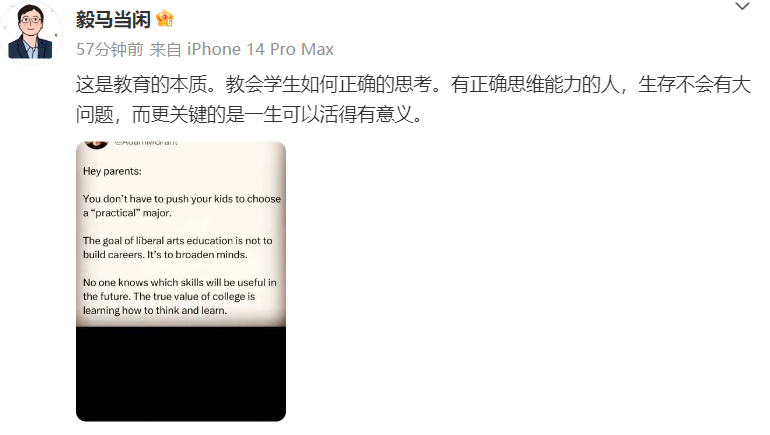
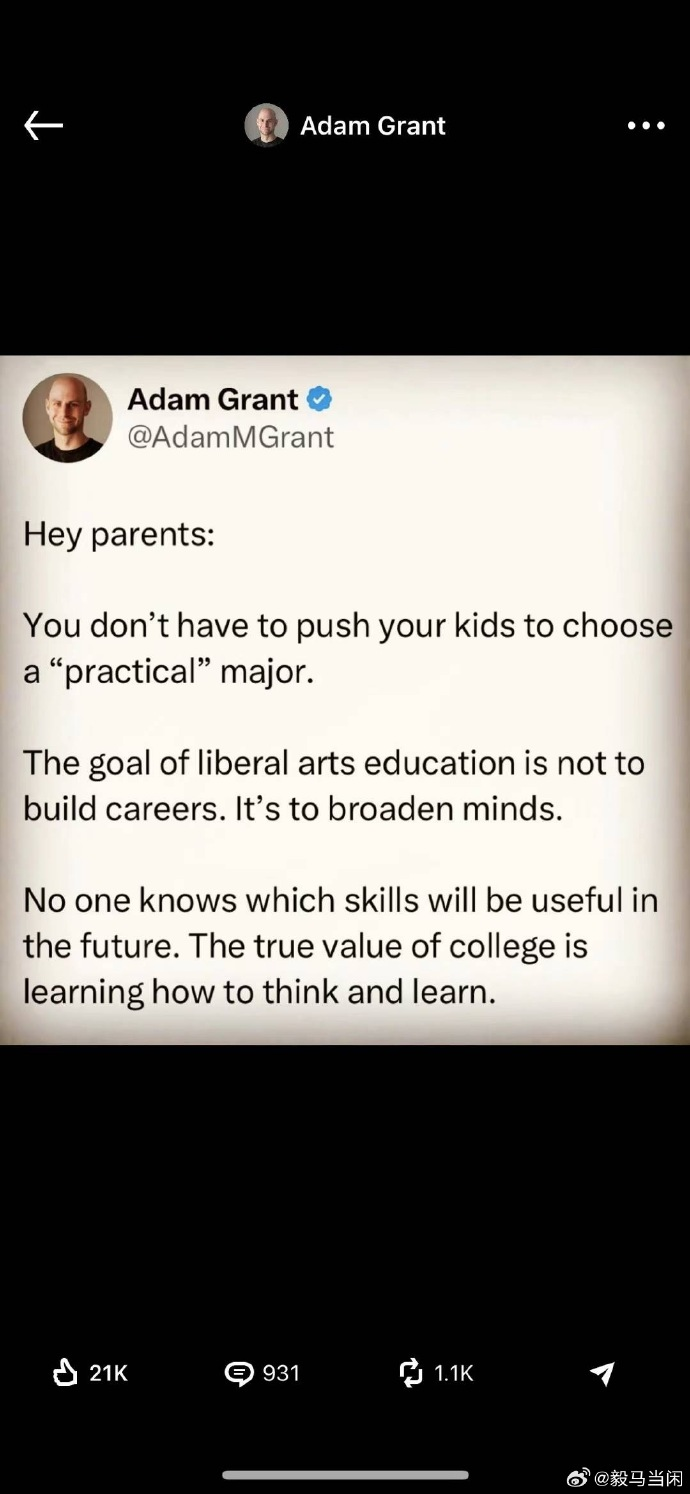
What majors should our colleges and universities offer, and how should our students and parents choose majors? How to make our life meaningful?

A brief discussion on the mathematical basis of surface classification
Demonic Arhat: Sheep Herding, Divorce, and the Relationship between Supervisors and Graduate Students

Machine-translated from the Chinese original 我们为什么歌唱 (published 2023-11-13). WeChat original ↗