
If you had a ball full of hair, could you comb all of its hair smooth? If you do an experiment, you will find that this is not possible. There will always be a hair that does not fall down, or a certain place that is not covered by hair. This is the "hairball theorem", which was first proved by Brouwer in 1912. It is also another version of the more famous Brouwer's fixed point theorem. Expressing the "hairy ball theorem" in mathematical language is: any continuous tangential vector field on the sphere has at least one point that is zero. Since wind can be thought of as a vector with magnitude and direction, the theorem states that no matter how many places on the Earth's surface the wind blows, there is at least one point where the horizontal wind speed is zero. Interestingly, the hairball theorem does not apply to torus surfaces (such as donut surfaces). Therefore, it is theoretically possible to create a hairy donut with all the hairs smooth. Perfectionists may prefer this donut.
Who is Brouwer? A great Dutch mathematician, he mainly studies topology and mathematical foundations. He is the founder and representative of the "intuitionism" school, one of the three major mathematical schools in the 20th century.
Brouwer proved the fixed point theorem named after him in 1909. Later, he proposed revolutionary concepts and methods and gave new proofs many times. For example, in 1911, he proposed the concept of "mapping degree" and combined it with the newly introduced "homopy" method to prove the 2-dimensional Brouwer fixed point theorem. It has now become a common proof method in textbooks, which will be introduced in detail below. In addition, Brouwer also proved that dimension is a topological invariant in 1910; he also created the simple approximation method, which gave the proof of topology a strict foundation. These achievements made him recognized as Poincaré's most important descendant of algebraic topology in the early 20th century.
Genius's ideas are always unexpected. When people expected Brouwer to lead everyone in the world of topology like Poincaré, he devoted himself without hesitation to the study of the basics of mathematics, and was determined to build mathematics on the basis of "intuitionism" that he recognized. Brouwer put forward a famous slogan: "To exist is to be constructed." This school of thought later spread to the American mathematician Errett Bishop and was called "constructivism." Professor Harold M. Edwards of the Courant Institute of Mathematical Sciences in the United States is an active advocate of this school of thought. He gave a good explanation of the constructivist method in his 2004 book "Essays in Constructive Mathematics". Professor Edwards believes that constructivism has now had its day, as powerful computers have become available, and that many of the mathematical results achieved since 1880 will appear to have been misunderstood once people have made appropriate adjustments to their thinking.
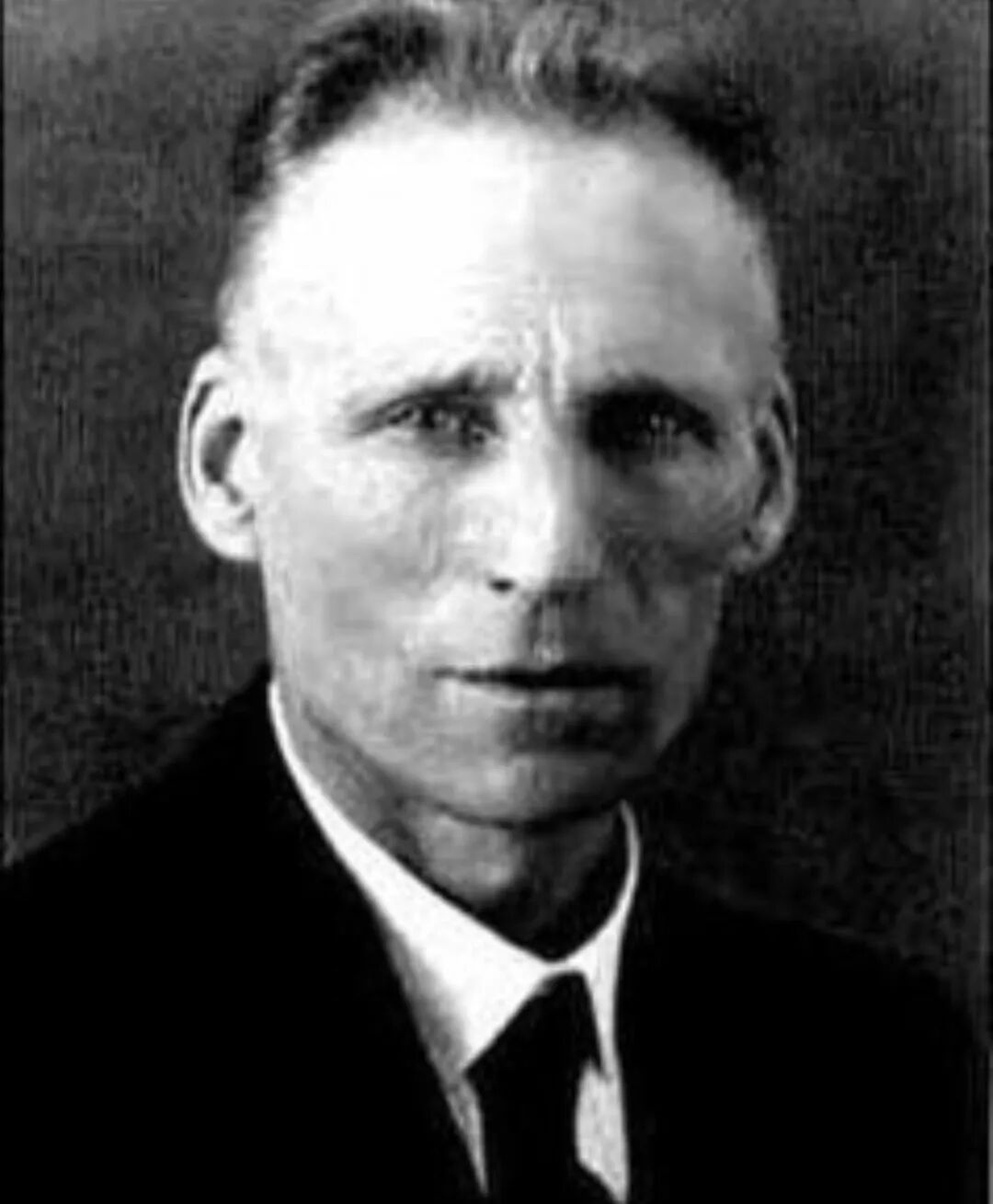
Brouwer was talented and had a strong philosophical temperament, which can be seen from his photos. His melancholy and deep eyes, with a hint of asceticism and asceticism, are somewhat similar to Wittgenstein. If he were given a clerical robe, he would become the Archdeacon Claude in the great French writer Victor Hugo's "The Hunchback of Notre Dame." The constraints of mathematics (canonical rules) could not withstand his love for philosophy (the gypsy girl Esmeralda). In his later years, he even overturned his previous mathematical achievements for the sake of philosophy, just because the law of excluded middle used in the proof did not meet the requirements of "intuitive constructability"! Even his compatriot Van der Waerden could not stand this shocking rebellious behavior, saying that he was "a very strange man who loves his philosophy crazily." From a secular perspective, Van der Walden's evaluation is pertinent; but in Brouwer's heart, there may have always been such a "fixed point" belief: only monks who dare to devote themselves to true love can be a good mathematician!
Brouwer's fixed point theorem
Brouwer Fixed-point Theorem is an amazing discovery in topology and one of the most useful theorems in mathematics. The theorem says that a continuous mapping of a sphere (of any dimension) onto itself leaves at least one point stationary.

To visualize this theorem, we can do an experiment. Suppose you stack two identical drawings on top of each other. Every point on the upper drawing is directly above the corresponding point on the lower drawing. You take the top drawing, crumple it into a ball without tearing it, and then place it back on top of the other drawing, taking care not to exceed the boundaries of the lower drawing. Now let me ask you: Is at least one point in the paper ball above still directly above its original corresponding point? Brouwer's fixed point theorem tells us that the answer is yes. This is why we often see "You are here" map signs in large shopping malls or parks.
The same theorem works in three dimensions. For example, when you stir a glass of liquid, even if all the "points" in the liquid (which can be imagined to be smaller than atoms and spatially dense) have moved, Brouwer's fixed point theorem states that there is at least one "point" in the liquid whose position is exactly the same as before you started stirring.
If expressed in a more precise mathematical language, the n-dimensional Brouwer fixed point theorem is: a continuous mapping f from an n-dimensional sphere to itself: Bⁿ →Bⁿ at least one point remains stationary, that is, there is a point x∈Bⁿ such that f(x)=x.
The following introduces several proof methods of Brouwer's fixed point theorem in 1-dimensional and 2-dimensional cases. In general, the n-dimensional case can be proved by following the 2-dimensional case by replacing the basic group with the (n-1)-dimensional homology group.
1D Brouwer’s fixed point theorem
The continuous mapping f from a 1-dimensional sphere to itself: B¹ →B¹ must keep at least one point stationary, that is, there is a point x∈B¹ such that f(x)=x.
Because the 1-dimensional sphere is homeomorphic to the unit interval =[0,1], the 1-dimensional fixed point theorem can also be expressed as: assuming f: → is a continuous map, then there exists x∈ such that f(x)=x.
The 1-dimensional case is relatively simple and can be proved by using the intermediate value theorem of continuous functions:
If f(0)=0 or f(1)=1, the theorem is obviously true. Suppose f(0)>0 and f(1)<1. Define the map g: →R such that for any t∈, g(t)=t-f(t). It is easy to verify that g is a continuous map, and then g(0)<0 and g(1)>0. From the intermediate value theorem, we know that there exists x∈ such that g(x)=x-f(x)=0, that is, f(x)=x.
Connectivity can also be used to prove:
Suppose there is no x∈ such that f(x)=x, then there is
But f(0)>0, f(1)<1, so the sets at both ends of the above formula are not empty. From the continuity of f, it can be seen that they are both open sets, so it can be expressed as the union of a pair of separated non-empty open sets, which is inconsistent with being connected.
2D Brouwer’s fixed point theorem
The continuous mapping f from the 2-dimensional sphere to itself: B² →B² must keep at least one point stationary, that is, there is a point x∈B² such that f(x)=x.
Because a 2-dimensional sphere is a disk D, the 2-dimensional fixed point theorem can also be expressed as: assuming f: D→D is a continuous mapping, then there exists x∈D such that f(x)=x.
Proof method one: Use mapping degree to prove
so-calledMapping degree(degree) is a measure of how many times a circular function f: S¹→S¹ wraps around itself, recorded as deg(f). If f is a constant mapping, that is, f(θ)=0, then deg(f)=0; if f is an identity mapping, that is, f(θ)=θ, then deg(f)=1; if f is a reflection, that is, f(θ)=-θ, then deg (f)=-1; For the general function cₙ(θ)=nθ, there is a unique n∈Z such that f is homotopic with cₙ(θ)=nθ, so deg(f)=n.
Assuming that f: D→D has no fixed point, a continuous mapping can be defined (here ||x|| represents the length of the two-dimensional vector)
Let g be G on S¹Limit mapping(restriction map), that is, g=G|s¹. On the one hand, homotopy can be defined because H(x,0)≡G(0), H(x,1)=g(x), g is homotopic to the constant map G(0), so g is null homotopic, so deg(g)=0.
On the other hand, if two mappings u, v: Then hₜ defines a shift from u to v on Sⁿ.
Now for any x∈S¹, there will be g(x)≠-x. Otherwise, suppose there is x∈S¹ such that g(x)= = -x, let a=||
From g(x)≠-x and the previously proved conclusion, we can see that g is homotopic to the identity map of S¹, that is, g, so deg(g)=1. This leads to a contradiction, indicating that f must have a fixed point.
Proof method two: Use the basic group to prove
First prove the 2-dimensional non-contraction theorem, and then prove the 2-dimensional Brouwer fixed point theorem.
Suppose A is a non-empty subset of topological space X. If the continuous map r:shrink mapping(retraction). If there is a contraction map from X to A, then A is said to be a member of Xcontractile core(retract).
It is easy to know that in every topological space, any single point set is the contraction core of this space; in every connected space, any subset composed of two different points is not the contraction core of this space.
proband2Dnon-contraction theorem(No-retraction theorem): The contraction from the disk D to the circumferential boundary S¹ does not exist. In other words, S¹ is not a contraction kernel of D.
Proof by contradiction: Suppose S¹ is a contraction kernel of D, then there is a contraction map r: D→S¹, so we can gettopological spacewithcontinuous mappingofexchange chart(commutative diagram):
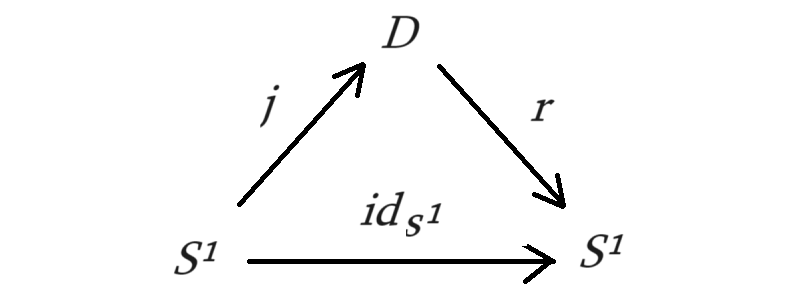
where j is an injective. Thus according to induced homomorphismfunctor(functor) property, availablegroupwithhomomorphismofexchange chart:
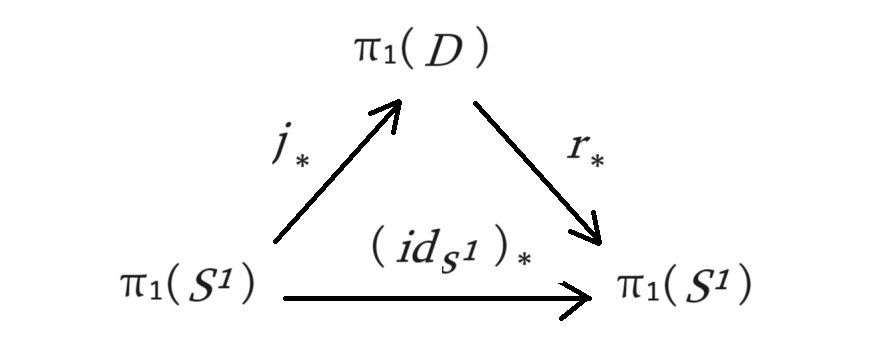
Prove again the 2D fixed point theorem:
Assume that the continuous map f: D→ D has no fixed points. For each x∈D, we have f(x)∈D and f(x)≠x. Draw a ray from f(x) to x, and the intersection with S¹ is denoted as r(x). Obviously, when x∈S¹, r(x)=x; on the other hand, from the continuous dependence of r(x) on x and f, we know that r(x) is a continuous function. Therefore, we get a contraction map r from D to S¹: D→S¹, which is inconsistent with the 2-dimensional non-contraction theorem.
Regarding the proof of the continuity of r(x), in addition to appealing to intuition, we can also give a strict expression.
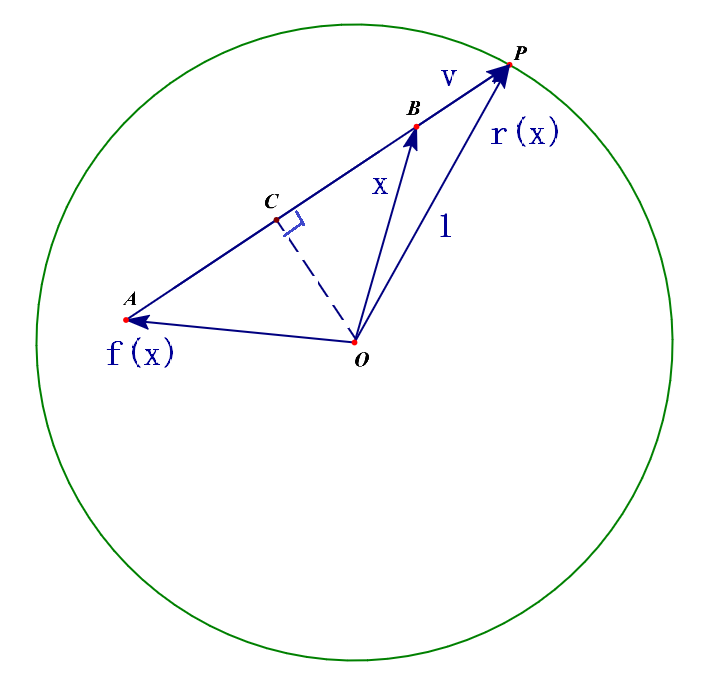
As shown in the figure, , , , . OP is the radius of the unit circle and the length is 1.
For any x∈D, r(x)=x+v=x+ut.
where u is the unit vector of v, then
t isvmodule, that is, t=||v||=BP=PC-BC,BC=x⊙u(⊙ represents the inner product operation), therefore
It is obvious from this expressionrIt is also easy to verify that it is indeed a contraction map from D to S¹. But according to the non-contraction theorem, S¹ is not a contraction kernel of D, which is a contradiction.
Proof 3: Vector field
This is the method in Mungres' textbook "Topology", which is roughly divided into three steps:
1. Use the fundamental group to prove the 2-dimensional non-contraction theorem. This has been introduced before and will not be repeated here. It leads to a corollary: the inclusion map j: S¹→R²-0 is non-zero,identity mapping(ideneity map) i: S¹→S¹ is non-zero. This corollary will be used below.
2. Prove: A non-zero vector field on the disk must point directly inward at one point on the circumferential boundary, and point directly outward at another point.
The proof idea is as follows:
First assume that there are no points on the circumferential boundary that point directly to the interior. Because it is a non-zero vector field, v(x)≠0, that is, the mapping v: D→R²-0, let w be the mapping that limits v to S¹, that is, w=v|s¹, because w can extend (extends) to v, so w is zero.
On the other hand, we can prove that w is homotopic to the inclusion map j: S¹→R²-0, and we can define a linear homotopy shift:
F(x, t)=tx+(1-t)w(x) for x∈S¹
When t=0 or 1, it is obvious that F(x, t)≠0; when 0<t<1, if F(x, t)=0, then w(x)= , that is, the scalar coefficient of x is negative, which means that w(x) points directly inward at point x, which is inconsistent with the assumption. So F(x, t)≠0, meeting the requirements of a non-zero vector field. Therefore, w is homotopic to j, so j is also zero-topic. However, according to the previous inference, it can be seen that j is non-zero-topic, which is contradictory. Therefore, the non-zero vector field must point directly inward at a point on the circumferential boundary. In the same way, it can also be proved that there must be a point directly pointing outside.
3. Prove the 2-dimensional Brouwer fixed point theorem.
Proof by contradiction: Assume that f(x)≠x for all x∈D. Let v(x)=f(x)-x, then (x, v(x)) is a non-zero vector field on D. However, this vector field cannot point directly to the outside at any point on the circumference S¹, otherwise f(x)-x=ax (a>0), then f(x)=(1+a)x will be located outside disk D, which leads to a contradiction.
Proof History of Brouwer’s Fixed Point Theorem
As early as 1909, Brouwer studied the continuous mapping f of the two-dimensional sphere S² to itself. He first assumed that f is a continuous bijection (and thus a homeomorphism) and remains oriented. He proved that there is at least one fixed point x of f, such that f(x)=x. This proof took up 9 pages and used complex reasoning about the deformation of curves on S². 1910 In 2008, he gave a new proof of this result, which is a corollary of the theorem that a continuous vector field on S² must have a singularity. Another complex reasoning is used here.
By 1911, when Brouwer gave the definition of mapping degree, he knew that he could use this concept to prove that when the continuous mapping f: S→S² satisfies the condition deg(f)≠(-1)ⁿ⁺¹, there is at least one fixed point. This theorem is equivalent to: if f has no fixed point, then deg(f)=(-1)ⁿ⁺¹.
His first proof was not simple, using the calculation of the sum of the exponentials of a continuous vector field with an isolated singularity on Sⁿ.
In the next article, Brouwer obtained a simple proof that does not require a vector field: if f has no fixed points, the great arc connecting f and f(z) provides a shift that turns f into a radial map a:
The above theorem did not attract much attention from mathematicians at that time. Maybe they were not familiar with the new concept of mapping degree. On the contrary, people are very interested in one of Brouwer's corollaries. Suppose g is a continuous mapping from the cube to itself, then g must have at least one fixed point. Brouwer proved as follows: Replace with the upper semi-closed sphere of Sⁿ, because both are homeomorphic. Then g is extended symmetrically about the equator into a continuous mapping f: Sⁿ→ ⊆Sⁿ. Because f, which is a continuous mapping from Sⁿ to itself, is not surjective, deg(f)=0. From the above theorem, we know that f has at least one fixed point. This fixed point of f must be located within , so this point must be a fixed point of g.
This corollary is now known in various contexts as Brouwer's fixed point theorem. It is of great interest because it requires no mapping other than continuity and can be widely used to find the existence of solutions to equations.
The fixed point theorem was later extended to the case of infinite dimensions, which is particularly important in applications. Birkhoff and Kellogg were the first to extend it to function spaces in 1922, proving that the fixed point theorem is true in . Subsequently, Schauder extended it to compact convex sets in any normed space in 1930. Tychonorff further proved in 1935 that any compact convex set in a locally convex space also has fixed point properties. In 1941, Japanese mathematician Kakutani extended it to multi-valued images (set-valued functions) and proved that any non-empty compact convex set in Euclidean real space has the "Kakutani fixed point property". This theorem is called "Kakutani's fixed point theorem". Nash used this theorem to prove the Nash equilibrium existence theorem of N-person games. Arrow and Debreu used this theorem to prove the general equilibrium existence theorem of "N people-M resources-K products", which is the theoretical basis of game theory and mathematical economics.
References
[1] [US] Clifford Pickover. The Book of Mathematics [M]. 2nd edition. Translated by Yang Dadi. Chongqing: Chongqing University Press, 2021.
[2] [US] John Derbyshire. The History of Algebra: Humanity’s Perseverance in Tracking Unknown Quantities[M]. Revised edition. Translated by Zhang Hao. Beijing: People’s Posts and Telecommunications Press, 2021.
[3] [English] Mark Armstrong. Basic Topology [M]. 2nd edition. Translated by Sun Yifeng. Beijing: People's Posts and Telecommunications Press, 2019.
[4] Xiong Jincheng. Lecture Notes on Point Set Topology[M]. Beijing: Higher Education Press, 2011.
[5] Bao Zhiqiang. Introduction to Point Set Topology and Algebraic Topology[M]. Beijing: Peking University Press, 2013.
[6] [US] James R. munkres. Topology [M], 2nd edition. Beijing: Machinery Industry Press, 2022.
[7] Gan Danyan. A brief history of algebraic topology and differential topology[M]. Harbin: Harbin Institute of Technology Press, 2021.

Welcome to share - learn and exchange - spread ideas
Machine-translated from the Chinese original 布劳威尔和他的不动点定理 (published 2023-12-18). WeChat original ↗