
Topology, that part of geometry concerned with the properties of figures invariant under transformations that are continuous and have continuous inverses, grew from various roots in the nineteenth century to become a full-fledged division of mathematics by early in the twentieth century. The two branches of the subject to be considered here are point-set topology (also called general topology), concerned with the properties of sets of points of some abstract "space," and combinatorial topology, concerned with how geometrical objects are built up out of certain well-defined "building blocks."
Note: There were two branches of topology at the beginning of the 20th century: point set topology (also called general topology), which focuses on the properties of point sets in certain abstract "spaces"; combinatorial topology, which focuses on how to construct geometric objects using certain well-defined "building blocks".
Point-set topology grew out of Cantor's studies of sets of real numbers. As such, its central aim is to provide an appropriate context for generalizing such properties of the real numbers as the Bolzano-Weierstrass property and the Heine-Borel property. Both of these are closely related to the important modern notion of compactness, a notion central in the generalization of the theorem on the existence of a maximum of a continuous function on a closed interval. The Bolzano-Weierstrass property is the property that every bounded infinite set of real numbers contains at least one point of accumulation, a point in every open interval of which there is another point of the set. In other words, this property asserts the "completeness" of the real numbers.
The Heine-Borel property, formulated by Emile Borel (1871-1956) in 1894, states that if an infinite set A of intervals covers a finite closed interval B of real numbers, in the sense that every number of B lies in the interior of at least one element of A, then there is a finite subset of A that has the same property. (Every open cover of a bounded closed set has a finite subcover)
Although Heine had used this result implicitly in the 1870s, it was Borel who first stated and proved this theorem with respect to a countable set. Henri Lebesgue (1875-1941) generalized it to arbitrary infinite collections in 1904.
Note: The following introduces Borel's proof by contradiction, using the closed interval set of dichotomies to prove the Heine-Borel property (finite coverage theorem).
Borel's proof is by contradiction. Let . If the conclusion is not true, then for every there is a point such that is not in , for every . If one bisects the interval , the same statement is true for at least one of the halves. If one continues this bisection process, one obtains a decreasing nested sequence of closed intervals , each of which has the same property as itself. But contains a point . By hypothesis, is in the interior of for some , so must contain one of the intervals , a contradiction.
The key to Borel's proof is what is often called the nested interval property, that the intersection of a nested family of closed intervals contains a point. It was this result that was later to be abstracted into the earliest definition of compactness. It was also this result that was among the earliest presented in the first systematic exposition of set theory as a whole, the 1906 Theory of Sets of Points by William Henry Young (William Henry Young) and Grace Chisholm Young.
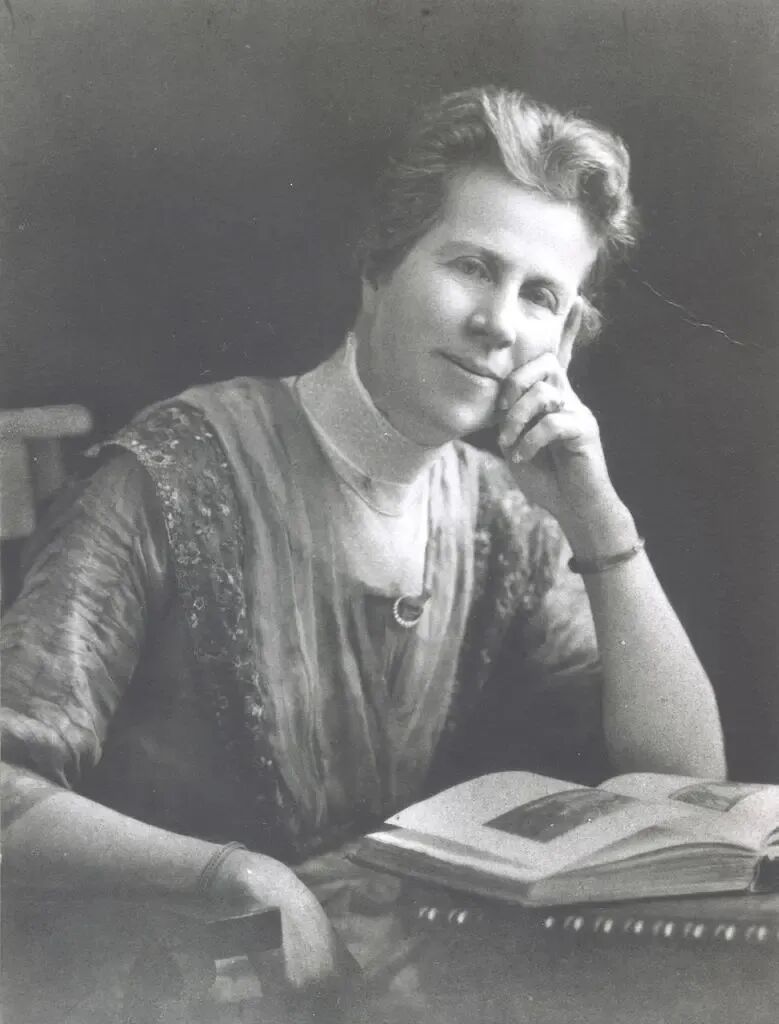
Grace Chisholm Young (1868-1944) was a British mathematician. She was educated at Gidon College, Cambridge, England, and continued her studies at the University of Göttingen in Germany, where she received her PhD in 1895. Her early works were published under the name of her husband, William Henry Young (1863-1942), and they collaborated in mathematics throughout their lives.
The Youngs and The Theory of Sets of Points
Mr. and Mrs. Yang and "Dianji Theory"
The text of the Youngs deals with sets of points on the real line or in the real plane and gives explicit definitions of many fundamental concepts that were later to be generalized. For example, a point x that belongs to an interval "unclosed" at both ends is said to be an internal point of the corresponding closed interval. A point L is said to be a limit point of a given set of real numbers if inside every interval containing L as an internal point there is a point of the set other than L. that contains all its limit points is said to be closed, while one that does not is said to be unclosed or open. (Note: The definition of open set here is different from the open set we use now.) The Youngs then reformulated the Bolzano-Weierstrass and Heine-Borel theorems in terms of these definitions and presented proofs.
The Youngs next generalized the notion of "interval" in the line to that of "region" in the plane by considering the latter to be generated by a set of triangles contained in it and then generalized the notion of limit point by replacing "interval" by "region."
Note: The Yangs used "area" on the plane instead of "interval" on the straight line to promote the concept of limit.
They noted further that, in analogy with the properties of an interval, a region divides the plane into three disjoint sets, internal points (those internal to at least one generating triangle), boundary points (those other than internal points that are limit points of internal points), and external points (those that are neither internal points nor boundary points). They then easily stated and proved the generalizations of the Bolzano-Weierstrass and Heine-Borel theorems to the plane.
Another fundamental notion in modern topology, the idea of connectedness, stems from some considerations of Cantor. Cantor, as part of his work in dealing with the "continuum", the entire set of real numbers, tried to characterize this set. As part of this attempt, he found it necessary to define what it meant for the set to be in one piece. Because he saw this idea in terms of the minimal distance between points of the set being 0, he defined "connected" in terms of distance: A set T is connected if given any two points p and q in it and any positive number ε, there is a finite number of points t₁, t₂,…, tₙ in T such that the distances pt₁, t₁t₂,…, tₙq are all less than ε.
Note: Cantor (1845-1918) discovered from the study of the "continuum" of real numbers that it is necessary to define the concept of sets "connected together". Because he believed that this concept could be represented by the minimum distance between two points in the set being 0, he used distance to define "connectivity".
The Youngs, among others, realized that it would be better to give a definition not using distance, but purely in set-theoretic terms, so they translated this notion as follows: "A set of points such that, describing a region in any manner round each point and each limiting point of the set as internal point, these regions always generate a single region, is said to be a connected set provided it contains more than one point." Using this definition, the authors then proved that a set is connected if and only if it cannot be divided into two closed components without common points.
The Yangs and others realized that it would be better to give a definition that did not use distances but was entirely in set theoretical terms, so they reformulated the concept as follows: "Let a set of points form a region around it in any way with every point and every limit point of the set as interior points, and let these regions always generate a single district. If the set contains more than one point, it is called a connected set." Using this definition, they proved that a set is connected if and only if it cannot be divided into two closed subsets with no common points.
Fréchet and Function Spaces
Flechet and function space
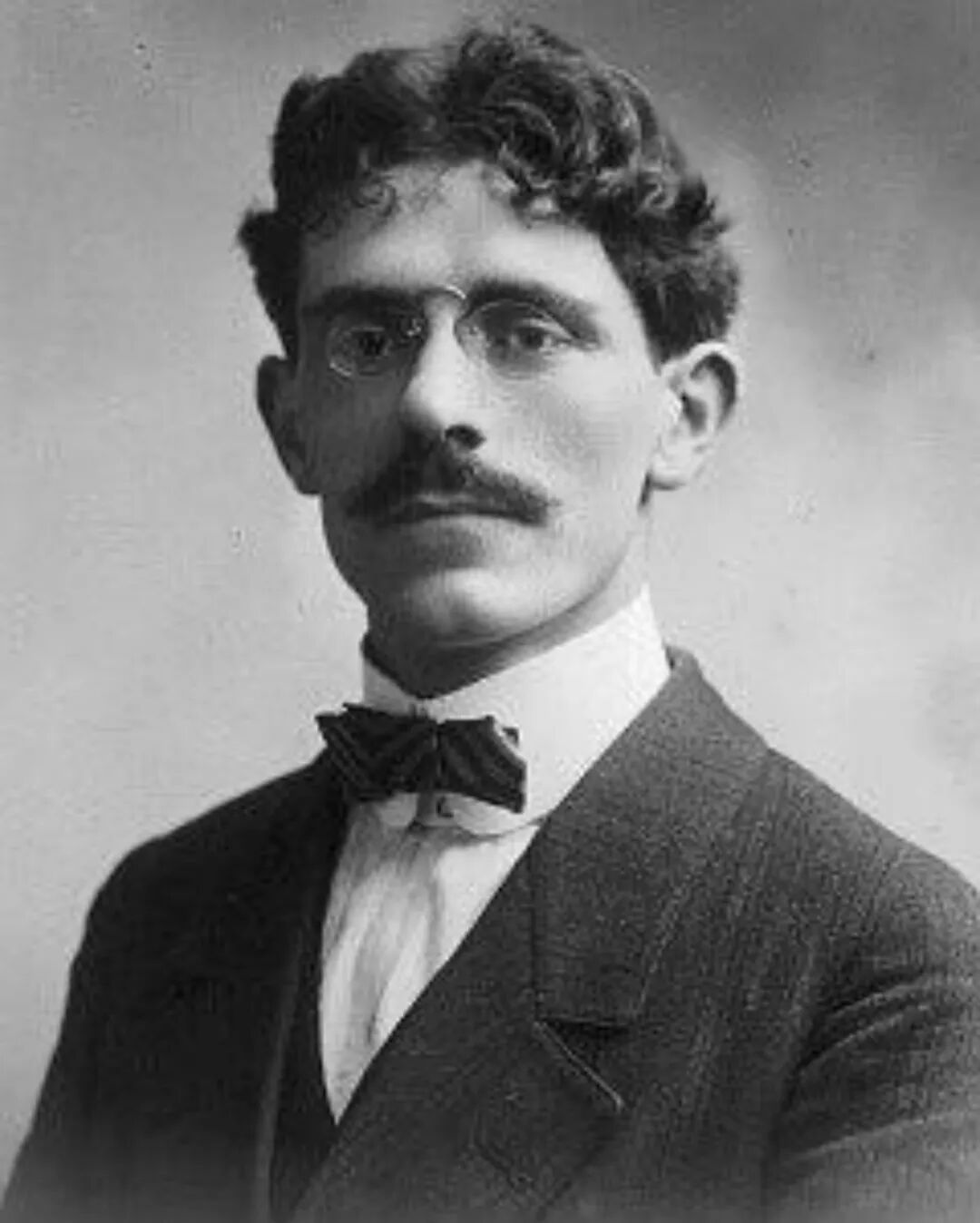
(Réne-Maurice Fréchet,1878-1973)
French mathematician, one of the founders of functional analysis
In the same year as the Youngs text appeared, Maurice Fréchet began the process of generalizing results on points in the plane to more general contexts. In his dissertation dealing with the theory of functionals, functions operating on certain sets of functions, he had to be able to decide when two functions were "close" to each other and therefore decided "to establish systematically certain fundamental principles of the Functional Calculus, and then to apply them to certain concrete examples." By doing so, "one often gains thereby from seeing more clearly that which was essential in the demonstration, …from the simplification, and in the freeing [of the proofs] from that which only depends on the particular nature of the elements considered." In other words, Fréchet decided to reconsider the basic notions of the topology of the real line in terms of arbitrary sets and then apply these notions to his particular sets of interest. He realized that he could prove numerous results of topology in a general context once and for all and then apply them in concrete instances rather than prove the same result over and over again.
He especially wanted to answer questions about convergence of functionals to limits and determine the circumstances under which the limit functional has the same properties as the functionals of which it is the limit.
In particular, he wanted to solve the problem of functionals converging to limits and determining the conditions under which limit functionals have the same properties as the functionals with which they are limits.
Fréchet thus began, not by defining "limit," but by characterizing the notion by means of axioms. That is, a set E belongs to L, the class for which limits are defined, if given any infinite subset of E it is possible to determine whether or not a unique element exists having appropriate properties. This element is to be the limit of . The limit element is subject to the conditions that if each , then the limit is , and if is the limit of , then it is also the limit of any subsequence of . With this abstract notion of a limit, Fréchet stated various definitions, some of which had already been considered by Cantor: The derived set E' of E is the set of its limit elements. The set E is closed if E' ⊆ E and perfect if E' = E. The point is an interior point of E if is not the limit of any sequence not in E.
If for any infinite subset of E it is possible to determine whether there is a unique element , with the appropriate properties, then E belongs to L, the class for which the limit is defined. This element is the limit of . The limit element must satisfy the following conditions: if for every , then the limit is ; if is the limit of , then it is also the limit of any subsequence of . With this abstract notion of a limit in mind, Flecher proposed various definitions, some of which were already considered by Cantor: The derivative E' of E is the set of its limit elements. If E'⊆E, then E is a closed set. If E' = E, then E is a complete set (Note: It is also called a perfect set because it has no isolated points). If is not the limit of any sequence outside E, then is an interior point of E.
As part of his study of functionals, Fréchet wanted to generalize the Heine-Weierstrass result on the existence of a maximum and minimum of a continuous function on a closed interval so that it could apply to function spaces. To accomplish this generalization, he took the central idea of the proof of the Heine-Borel theorem as a definition in a brief note of 1904: "We call a compact set every set E such that there always exists at least one element common to every infinite sequence of subsets E₁, E₂, …, Eₙ, … of E, if these (possessing at least one element each) are closed and each is contained in the preceding one." Fréchet then proved that a necessary and sufficient condition for a set E to be compact was that every infinite subset F had at least one limit element in E, an element that is the limit of some sequence of distinct points of F.
As part of his study of functionals, Flecher wanted to generalize the Heine-Weierstrass results on the existence of maxima and minima of continuous functions on closed intervals to apply to function spaces. To accomplish this generalization, he adopted as a definition the core idea of the proof of the Heine-Borrell theorem in a brief note from 1904: “We call a compact set any set E that satisfies the following condition: if every infinite sequence of subsets of E E₁, E₂, …, Eₙ, … (each subset has at least one element) are closed and each is contained in the previous subset, then there is always at least one common element among these subsets." Then, Flecher showed that a necessary and sufficient condition for a set E to be compact is that every infinite subset F has at least one limit element in E, that is, the limit of a sequence of some distinct points of F.
Note: Flecher gave the definition of "compactness" of the metric space X based on the Bolzano-Weierstrass theorem (bounded real number sequences must have convergent subsequences): every sequence in The gathering point of the subset can be regarded as a natural extension of the limit of the subsequence, so another definition of "compactness" is given: every infinite subset in X has a limit point. The first definition is now called "sequentially compact" and the second definition is called "limit point compact". These two definitions are equivalent in metric space. Later, it was discovered that using sequences and limits to describe general topological structures was not sufficient, so the Russian mathematicians Aleksandrov (1896-1982) and Urysohn (1898-1924) replaced it with an "open covering version" based on the Heine-Borel theorem, which is our current definition of "compact": every open covering of X has a finite subcover.
"Tight" implies "tight at the extreme point", but not vice versa. For example, a minimal uncountable well-ordered set is not compact because it has no maximum element, but it is limit-point compact. It can also be seen from this that it is immeasurable. In addition, compact spaces that satisfy the first countability axiom are sequence compact spaces. The metric space satisfies the first countability axiom and the T₁ separation axiom. For metric spaces, "compactness", "limit point compactness" and "sequence compactness" are all equivalent.
Noting that compact sets by his definition had properties analogous to those of closed and bounded sets in space, Fréchet was able to generalize the Weierstrass result, using for his definition of continuity the property that today is generally known as sequential continuity: A function is continuous at in the closed set if for all sequences in that converge to .
Noting that the compact sets he defined have similar properties to bounded closed sets in space, Flecher was able to generalize Weierstrass's result by applying to his definition of continuity what today is generally called sequence continuity: a function is continuous at a point in a closed set if , for all sequences in that converge to .
Interestingly, in his dissertation of 1906, Fréchet took for his definition of "compact" the necessary and sufficient condition above rather than the intersection property, adding the statement that any finite set will also be considered compact. (finite sets are compact)
Having shown that the concept of a distance was not necessary to develop various familiar notions, Fréchet proceeded to reintroduce that notion in a more general setting. Namely, he considered a subclass E of the class L consisting of members E in which can be defined a metric, a real valued function satisfying
(1) ;
(2) if and only if ;
(3)
for any three elements of E. Using the metric, Fréchet defined a Cauchy sequence to be any sequence such that for every there is an so that for all , we have . Limit elements and the concepts associated with them are then defined in terms of the metric and Cauchy sequences.
Note: Flecher generalized distance as a metric concept, defined Cauchy sequence and limit concepts, and used these concepts to define topological properties such as compactness, divisibility, and completeness, thereby establishing related theories of metric spaces. If the function is regarded as a "point" in the space and the norm is defined, the function space also becomes a metric space. Flecher's work laid a solid foundation for point set topology and functional analysis.
In particular, Fréchet considered the subclass of normal sets consisting of sets that are perfect, separable (contain a countable dense subset), and in which every Cauchy sequence has a limit (complete, in modern terminology). It is for sets of this type that he could prove a generalization of the Heine-Borel theorem: A normal set E is compact if and only if for every collection G of sets such that every element of E is in the interior of at least one member of that collection, there exists a finite subset of G with the same property.
In particular, Flecher considered subclasses of well-ordered sets consisting of complete, divisible (containing a countably dense subset) sets, and in which every Cauchy sequence has a limit (in modern terms, is complete). For sets of this type, he could prove a generalization of the Heine-Borrell theorem: a well-ordered set is compact if and only if for each set G such that every element of E is inside at least one member of the set, there exists a finite subset of S with the same property. (Note: In other words, every open cover has a finite subcover. This is also the current definition of compactness of topological spaces.)
Fréchet gave a number of examples of spaces with metrics for which his general theorems held, including examples of sets of functions. One such example was the set of real functions continuous on a given closed interval. Here the metric was the maximum norm under which Fréchet proved that the set was normal.
A second example was the set of all sequences of real numbers with the metric Fréchet noted that this metric is better than a more standard one in the sense that the former always gives a finite distance while the latter does not. Again, Fréchet showed that this set is normal and, furthermore, that the same is true for the set of real functions defined on it with an appropriate metric.
Hausdorff and Topological Spaces
Hausdorff and topological spaces
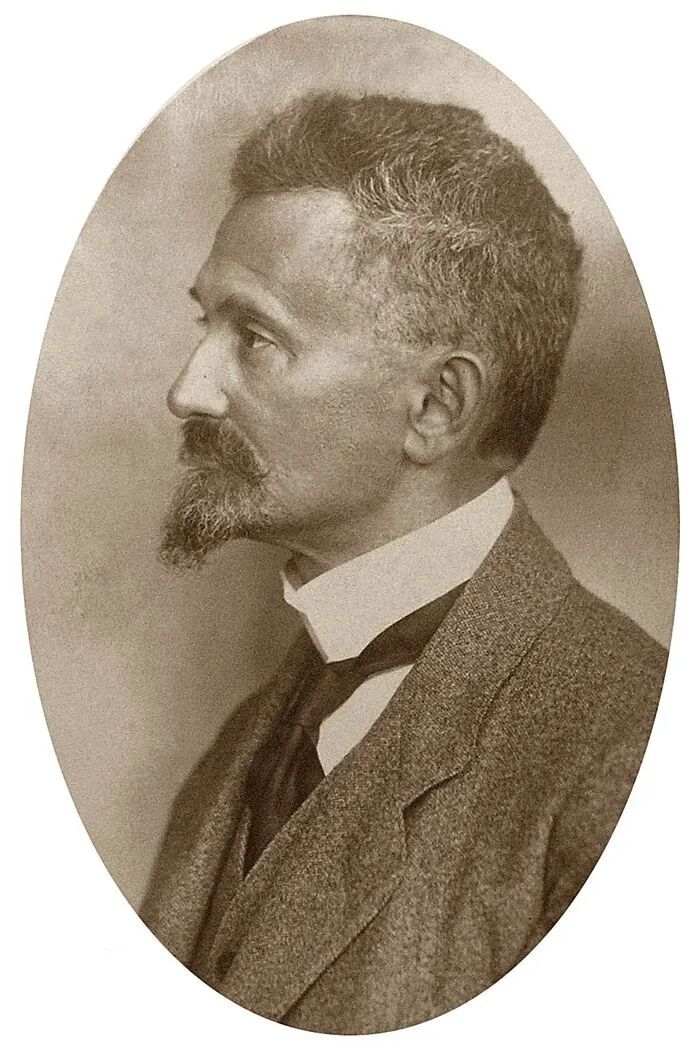
Felix Hausdorff
(Felix Hausdorff ,1868-1942)
German mathematician, one of the founders of topology
It was Felix Hausdorff who was able to give a full axiomatization of the notion of a topological space derived from standard properties of sets of real numbers. He described this axiomatization in his 1914 text, Grundzüge der Mengenlehre (Foundations of Set Theory).
Starting from the standard properties of the set of real numbers, it was Hausdorff who gave a complete axiomatic description of the concept of topological space. He described these axioms in his textbook "Foundations of Set Theory" published in 1914.
Although his axioms and definitions have been modified since 1914 and numerous subsidiary definitions and concepts have been introduced, the basics of point-set topology as currently taught are all to be found in this fundamental work.
Hausdorff noted that there are three basic concepts by means of which one can base a general theory of topological spaces, the notions of distance, neighborhoods, and limits.
Note: Hausdorff noticed that the three basic concepts of distance, neighborhood and limit are the basis for establishing the general theory of topological space. He also discovered that the relationship between these three basic concepts is: distance implies neighborhood and limit, and neighborhood implies limit. However, starting from the concept of limit, the definitions of distance and neighborhood cannot be obtained. The symbolic representation is: distance ⇒ neighborhood ⇒ limit.
Fréchet had in effect used both the first and the third. Hausdorff noted that if one begins with the concept of distance, one can derive the other two, while if one begins with that of neighborhood, one can define the notion of limits. In general, however, one cannot reverse these procedures.
Note: Fleischer used the two concepts of "distance" and "limit". He abstracted distance into measurement and then defined metric space and limit. Hausdorff decided to define topological spaces starting from the concept of "neighborhood". This kind of space is what is called Hausdorff space today.
Although the method one chooses, according to Hausdorff, is a matter of taste, he decided to begin with the concept of neighborhood to define the notion of a topological space. Such a space, today known as a Hausdorff space, is a set E to each element x of which is associated a collection of subsets of E, called neighborhoods, that satisfy the following axioms:
(1) Each point x belongs to at least one neighborhood , and every neighborhood contains x.
(2) If , are two neighborhoods of the same point x, then their intersection also contains a neighborhood of x.
(3) If , then there is a neighborhood such that .
(4) For two different points x, y there are two neighborhoods , whose intersection is empty.
Hausdorfftopological spaceIt is defined as a set with a family of subsets associated with each element x. These subsets are calledNeighborhood, they must satisfy the following four axioms:
(1) Each point x has at least one neighborhood , and each contains this point x. (Each point has a neighborhood that contains it)
(2) The intersection of two neighborhoods of x contains one neighborhood of x. (The intersection of any two neighborhoods of x is a neighborhood of x)
(3) If y is a point of , then there exists a such that . (Neighborhood contains other points in the neighborhood)
(4) If x≠y, then there exists and , so that the intersection with is the empty set. (Separated points have disjoint neighborhoods)
Note: The first three conditions are the neighborhood axiom system used to define topological space. The last condition was extracted separately and is calledHausdorff Propertiesoraxiom of separation, the topological space that satisfies this condition is calledHausdorff space。
After showing that a metric space, with the neighborhoods defined by for every real number , satisfies the axioms given, Hausdorff developed the same basic theory as had Fréchet. The major change is that the central concept now is the domain or, in more modern terms, the open set. For Hausdorff, a domain A is a subset of E containing only interior points, where the latter are defined as points x that have a neighborhood contained in A. That the entire set E and each of the neighborhoods are domains follows from axioms 1 and 3. Hausdorff also showed that the union of arbitrarily many domains and the intersection of finitely many are domains. (Note: The infinite union and finite intersection of open sets are still open sets. If you add another property: the set itself and the empty set are both open sets, it is the definition of topological space using open sets.) A closed set, on the other hand, is one that contains all of its accumulation points. (If a set contains all its gathering points, it is a closed set.) Hausdorff then showed that the closed sets are precisely the complements of the domains. (The complement of an open set is a closed set)
Using Fréchet's limit definition for compact sets, Hausdorff proved the intersection property of nested, closed, compact sets and then a generalization of the Heine-Borel theorem, modifying the original proof only slightly. He also gave a new definition of limit point and convergence general enough to apply in any topological space: The point x is a limit of the infinite set , if every neighborhood of x contains all but a finite number of points of . Each neighborhood of x includes all points in except a finite number of points. Further, because any set either has a single limit x or none at all, one writes in the first case that or that converges to x.
the other new definitions was one for connectedness: "A set differing from the empty set is connected if it cannot be divided into two disjoint, non-null, sets both closed relative to [that is, such that each set is the intersection with of a closed set in the ambient space ]." Hausdorff noted that because closed sets are the complements of domains, he could equally well have specified in the definition Among that the components needed to be.
Because the idea of a neighborhood was the point of departure for Hausdorff's development, it is not surprising that he defined continuity using that concept. Namely, he took the standard ε - δ definition of continuity for functions of a real variable, noted that this definition used neighborhoods on the real line, and then translated it into a general definition for topological spaces: "The function is called continuous at the point , if for each neighborhood of the point there exists a neighborhood of the point , whose image lies in ; i.e., . " Hausdorff then generated an equivalent definition: The function is continuous at if and only if, for each subset of which has as an interior point, the inverse image also contains the point as an interior point. Using this definition, it is easy to prove that a continuous function preserves connectedness and compactness. Hausdorff naturally noted that the first of these facts implies the intermediate value theorem while the second implies the existence of a maximum and minimum value for a continuous function on a closed interval. In other words, Hausdorff showed that a topological space is the natural setting for these classical results about functions of a real variable.
Note: Hausdorff constructed Hausdorff space through the concept of "neighborhood" and defined topological concepts such as open/closed sets, boundaries, limits, compactness, connectivity and continuity, thus creating a complete theory of abstract space, thus formally forming the branch of point set topology.

Postscript:
This article attempts to mix Chinese and English styles. The English history of mathematics comes from Victor J.Katz's "A History of Mathematics: An Introduction". Part of the content has been translated and annotated, and pictures have been added. The "Bilingual Route" takes you to a wider world.
This article talks about the creation of point set topology, mainly introducing the work of Yang and his wife, Flecher and Hausdorff. The reason why this branch of point set topology came into being is mainly due to two factors: First, mathematical analysis in the 19th century needed to find a more solid foundation. Cantor created set theory for this purpose, which provided a suitable mathematical language for point set topology; the other was the influence of axiomatic methods. Axiomatic ideas guided the development of mathematics throughout the 20th century, reaching its peak in the "structuralist" mathematics of the French Bourbaki school. The creation of point set topology reflects the overall trend of pursuing "generality" and "unity" in mathematics in the 20th century.
This article not only introduces the "what" and "how" of point set topology, but also explores the "why", that is, why these mathematical concepts are produced, and what factors guide its development and evolution. Of course, this short article cannot cover everything, and can only briefly discuss a few of the most basic concepts, such as Flecher's "metric", Hausdorff's "neighborhood" and various definitions of "compactness", etc. I hope this is a starting point and I will share it after more in-depth and comprehensive research in the future.

Welcome to share - learn and exchange - spread ideas
Machine-translated from the Chinese original The Establishment of Point-Set Topology(点集拓扑学的创立) (published 2023-12-19). WeChat original ↗