
The application of information technology by enterprises has two functions: one is to establish information media between people, people and machines, and machines to operate and execute business activities; the other is to support the management activities of enterprises and use information technology to help management - set goals, achieve goals, evaluate differences, and correct actions. The interactive combination of information technology and organizational personnel formed for this purpose is the "enterprise information system".
So how is an "enterprise information system" constituted? What information systems does the enterprise have? Mr. Guo’s university major is “Management Information Systems” (see “Talk about the Application of Artificial Intelligence in Enterprises on Fudan Campus”), and he also teaches MBA courses on enterprise information systems at Fudan and other educational institutions. My most recognized definition of this issue comes from the "Management Information System" (MIS, also known as "business information systems") which I have been studying since I was an undergraduate in the 1980s. It is also the authoritative textbook on the subject of enterprise information management to this day. Professors Laudon and his wife (Laudons) have continued to revise it for more than 30 years and iterated seventeen versions.
MIS defines enterprise information systems as three layers: operation layer system, management system and strategic layer system. The system names at these three layers are transaction processing system (TPS), management information system (MIS)/decision support system (DSS) and executive support system (ESS).
The ERP system we are talking about is a typical MIS system. Manufacturing execution, logistics processing, order processing, salary calculation, etc. all belong to the TPS system, while business intelligence and the leader's cockpit belong to the ESS system.
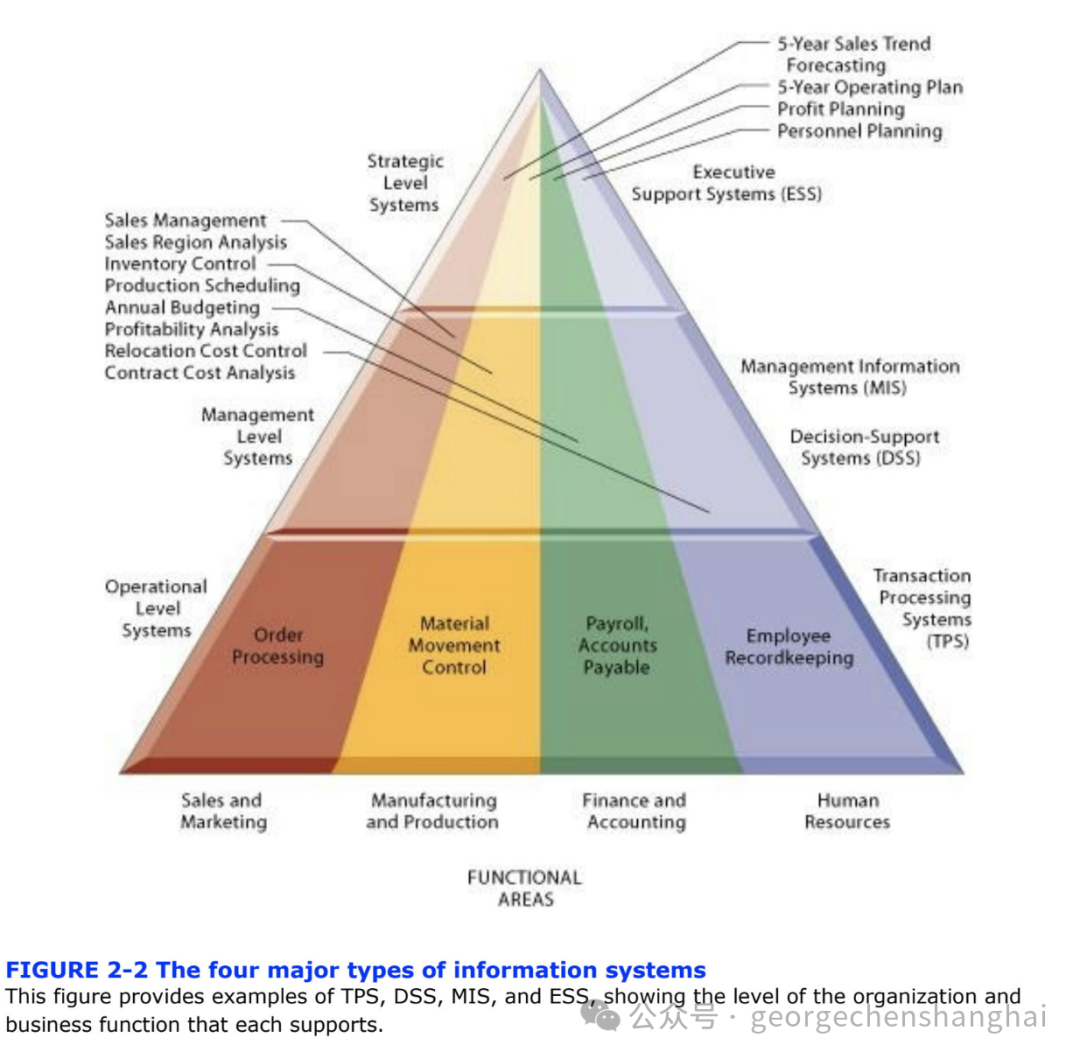
Although in the actual delivery of large-scale enterprise information systems, the division of these three levels is not very clear. For example, the SAP ERP system is mainly positioned in MIS and also covers certain aspects. In the TPS category, however, due to the use of technology, the granularity and timeliness of system information are indeed different among the various information systems of the enterprise. This also reflects the different needs for information at different organizational levels within the enterprise. Generally speaking, the higher the level in the organization, the more information needs to be summarized. They are consumers of information. The more basic they are, the more they are the generator of information itself, rather than the consumer of information.
The source of management information systems theory in the 1980s actually comes from Robert Anthony, the founder of management accounting, so I said in the video below that "management accounting" and "management information" are to a large extent the same discipline.
Harvard Business School professor Robert Anthony published "Planning and Control System" in 1965 (As an aside, System in English means system, system, and at the same time it means system and information system. In Chinese, when we say "system", we often think of a set of software and information systems, not an organizational system. Therefore, when I translate System, I will say it as "system" or "system" according to the contextual semantics.), a three-level "management control system" of enterprise strategy, control, and operation was proposed. Performance measurement at these three levels is called "management accounting." As a result, modern management accounting methods such as planning and budgeting, responsibility centers, profit analysis, cost control, and activity-based costing were produced.
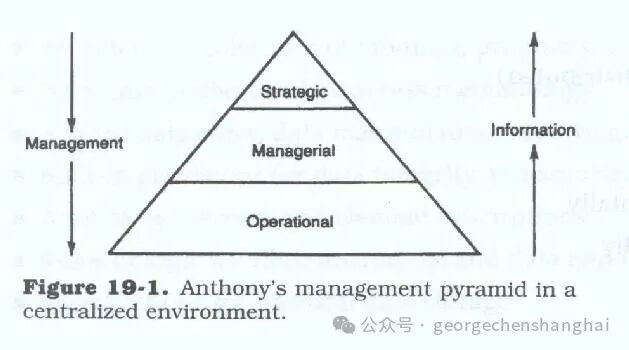
In the enterprise architecture developed at the beginning of the 21st century, common methods of business capability architecture, such as IBM's Enterprise Component Model (CBM, see "Business Architecture | Forever CBM"), also divide enterprise capabilities into three layers: strategy, control, and operation. In fact, the source of the theory lies in the management control system (management accounting) of the 1960s and the management information system of the 1980s.
The three-level division from the organizational structure to the information system reveals the enterprise information management paradigm of "management from top to bottom, information from bottom to top", that is: management intention is from high-level strategy to plan, and the plan guides grass-roots execution through middle-level managers, and managers correct deviations during the execution process; information is generated during the execution process, and is summarized layer by layer for managers' reference and senior-level decision-making.
It can be said that the main application characteristics of today's enterprise-level information technology are based on this three-layer model paradigm, specifically including:
- Based onrelational databaseFor enterprise application systems, relational databases require structured management of information to enable the addition, deletion, checking, and modification of information;
- Based onstructured informationData management requires data standardization. For example, the business information object of an order needs to be composed of standardized fields such as supplier name, material, price, quantity, delivery conditions, and delivery location;
- The tasks of adding, deleting, checking, and modifying data are arranged in time series to form a "process" and structured management of tasksbusiness process, constitutes the specification for the use of enterprise application information technology; if personnel do not follow the process when using the system, the system will not produce correct information;
- The interface between people and information systems isstructured information interactionMainly, for example, if the user wants to enter an order in the information system, he or she must enter standardized fields such as supplier name, material, price, quantity, delivery conditions, delivery location, etc. one by one in a screen with many "grids";
- Since high-level information technology focuses on information consumption (analysis), and grassroots-oriented information technology focuses on information generation (transactions), the two have different requirements for technical architecture. It can be compared to driving a sports car when driving on the road, and driving an off-road vehicle when driving in the mountains. Therefore, enterprise information systems are divided intoTransaction processing systems (OLTP) and analytical processing systems (OLAP)Two categories, ERP, CRM, human resource management systems, etc. belong to OLTP, and business intelligence, supply chain optimization, recommendation algorithms, risk control, etc. belong to OLAP. The technical architecture and implementation methods of these two types of systems are different.
- OLAP needs to be based on the data generated by OLTP, and can also integrate various data sources from the Internet and the Internet of Things, that is, "big data”
The emergence of artificial intelligence has fundamentally changed the way people interact with information and manage information. In the past few years, I have written many articles about the era of artificial intelligence and the new paradigm of enterprise-level information technology. I will not go into details here, including:
"The Corporate Nervousness of Looking for People | The Next-Generation Architecture of Enterprise Digitalization"
"GPS Navigation for Enterprise Operations | Process Simulation and Process Digital Twin"
"Artificial Intelligence and ERP | How big models reshape enterprise-level IT applications"
"Artificial Intelligence and the Automation of Work | AI and the automation of work"
"Next Generation ERP | How Artificial Intelligence Will Reshape Enterprise Solution Software"
"Hyperautomation | The ultimate form of business process digitization and ERP"
All in all, the characteristics of information processing in the era of artificial intelligence are:
-
Human-computer interaction methods range from structured information (human-computer interaction method is forms, information is managed in relational databases) to unstructured information (human-computer interaction method is natural language, or images and videos, information is managed in non-relational databases and vector databases)
-
Action tasks are all generated by AI. Now AI can even generate music and videos. Is it still difficult to generate processes and tasks? The person who performs the task may be a human or a robot - the robot that performs the task is an intelligent agent.
-
The process of information generation, insight, and decision-making has changed from sequential processing between multiple systems and the need for information processing between systems (this is why there is a "data center") to "near real-time" processing of data-driven execution.
Therefore, artificial intelligence transforms enterprise information systems, not only by adding intelligence to the use of traditional enterprise information systems, but also by adding an intelligent function to business processes or user system operation interfaces. For example, when customer service personnel in the sales department use the information system to process customer order requests, they were unable to perform real-time order deliverability checks in the past. However, with artificial intelligence, customers can accurately tell customers when their orders can be delivered after placing the order; artificial intelligence allows business managers to rethink the enterprise organization from scratch:
- Why do we need this customer service position in the sales department?
- Can artificial intelligence replace this position?
Therefore, information systems empowered by artificial intelligence, from organization, to processes, to user interfaces, are completely different from today’s information systems. The principles of enterprise information systems that have been practiced by academia and industry for sixty years will be changed:
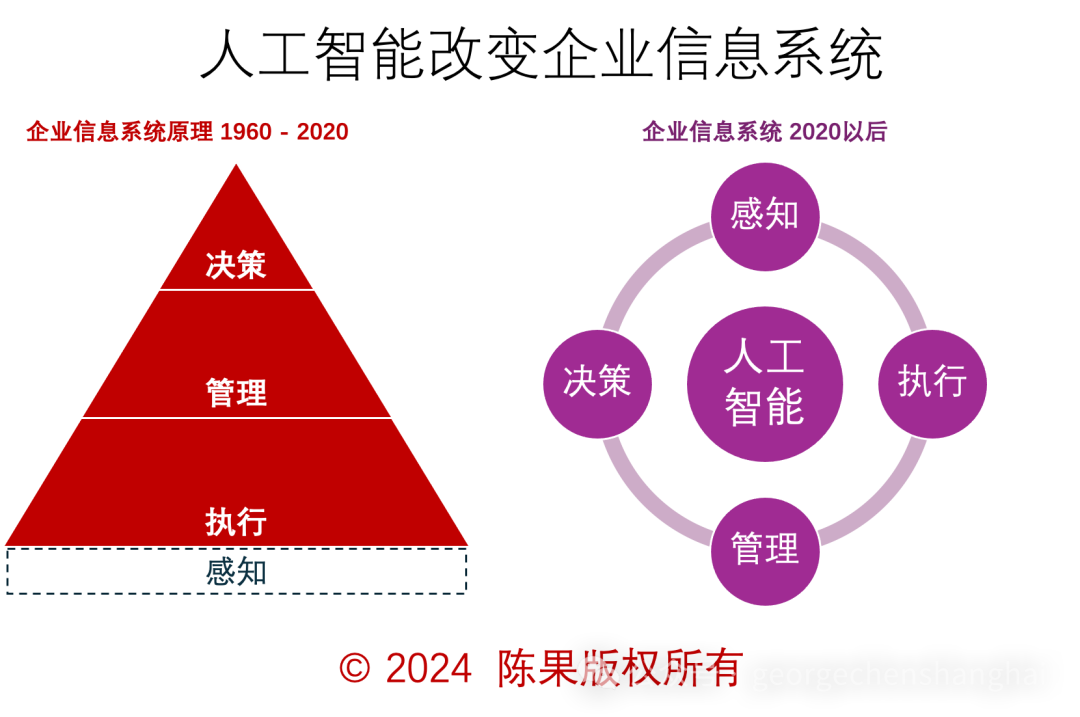
We can foresee that artificial intelligence will not change the enterprise information system. Enterprises with artificial intelligence will:
- Computers with screens and keyboards will disappear, and artificial intelligence may appear in the form of voice, embodied robots, etc.
- There is no current information system with a lot of boxes to enter data.
- People don’t find jobs according to business process requirements, but jobs find you automatically.
- Job responsibilities, business processes, and compensation and performance models in the industrialization era will all disappear
- Organizational hierarchy will disappear, no middle managers, no planning and budgeting
The above-mentioned organizational flattening and managerless organizational changes have been practiced in the past, such as various left-wing enterprise management revolutions that I have written about (see "Digital Transformation of Chinese Work Styles | Why Some People Can't Get OKR"). I believe that these organizational revolutions are just because the application of artificial intelligence is not yet mature, and they are just "utopian socialist" utopian revolutions. When Mr. Zhang Ruimin talked about quantum management and Rendanheyi, most people said they didn’t understand it because most people haven’t seen the success of artificial intelligence.
If you think what I said above is a bit abstract, then you can experience it in this video:
Machine-translated from the Chinese original 人工智能改变企业信息系统,那么未来的企业信息系统究竟会长成啥样? (published 2024-05-17). WeChat original ↗