This month’s theme:
1. Was Galileo wrong about mathematics?
2. Update of the shape of the universe
3. Topology and schizophrenia
|
Author: Tony Phillips, Professor at Stony Brook University 2024-6-1 Translator: zzllrr Xiaole (mathematics popular science public account) 2024-6-3 |
|---|
|
1. Was Galileo wrong about mathematics? |
|---|
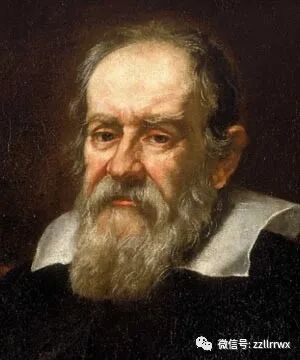
In 1623, Galileo Galilei (1564 - 1642) published Il Saggiatore (Il Saggiatore), his polemic with the Jesuit astronomer Orazio Grassi (1583 - 1654), a defender of the hybrid geocentric/heliocentric model of the solar system. In The Assayer, he compared the universe to a huge book that cannot be understood without first understanding its language and alphabet: "[That book] is written in the language of mathematics, and the letters are triangles, circles, and other geometric figures." Award-winning British science writer Philip Ball (1962 -) disagrees with this view. "Frankly, Galileo was wrong: mathematics is not the language of nature but a tool that we can use to make quantitative predictions about certain aspects of nature," Ball wrote in an opinion piece published April 24 in Chemistry World https://www.chemistryworld.com/opinion/making-sense-of-the-maths/4019357.article .
Bauer writes mainly about the life sciences, in effect taking Galileo out of context. Galileo was talking about astronomy and physics ("the universe"), not the medicine or life sciences of his day, as the word "nature" suggests. On the other hand, excluding Galileo, Bauer has a point. As he puts it, “There is a profound difference between using math and understanding science. That is, we need pictures and stories (‘cause-and-effect narratives’) to make equations make sense; often, says Bauer, “the math can even hide behind: If you can crank the handle and get the result, you can (temporarily) hide the fact that you don’t quite grasp the underlying science.” "
But why does science have to make sense? In fact, Bauer begins his article by quoting the discoverer of quantum mechanics, Werner Heisenberg (1901 - 1976) In a quote from 1930, he wrote: "It is not surprising that our language is unable to describe the processes taking place inside atoms, since it was invented to describe the experience of everyday life, which consists only of processes involving large numbers of atoms. More generally, why is it that our brains are able to understand the basic structure of the universe, or, for that matter, the basic structure of the human brain itself? Structure? Fortunately, as Heisenberg said, we have mathematics at our disposal that can safely lead us beyond what we can comfortably "understand". There may be parallel universes with different speeds of light, but there cannot be parallel universes where 47 is not prime. We should be grateful that we have this reliable guide and not complain when it sees better than what we can see.
|
2. Update on the shape of the universe |
|---|
What does our three-dimensional universe look like if it's not infinite? Presumably, it doesn't stop at one wall, it's three-dimensional everywhere; it's what we call a three-dimensional manifold. But just as a two-dimensional finite surface without boundaries can have different topologies (it can be a sphere, a torus, a 2-hole torus, etc.), there are many possible topologies in three dimensions.
Some three-dimensional topologies are excluded as possibilities for our universe because they do not match current observations. For example, according to current consensus https://wmap.gsfc.nasa.gov/universe/uni_shape.html , the universe is geometrically flat and therefore essentially like a three-dimensional Euclidean space in any region where we can examine the overall geometry. This rules out the simplest model of finite topology, a three-dimensional sphere, since a sphere requires an overall positive curvature. "Promise of Future Searches for Cosmic Topology," https://journals.aps.org/prl/pdf/10.1103/PhysRevLett.132.171501, published in Physical Review Letters on April 26, 2024, reviews the remaining options. One possibility is a three-dimensional torus, a space obtained by identifying the opposite sides of a cube. This image of what the interior of space looks like was used in a Physics review of the PRL article https://physics.aps.org/articles/v17/74.
Cubic lattice marked by ever-extending frame
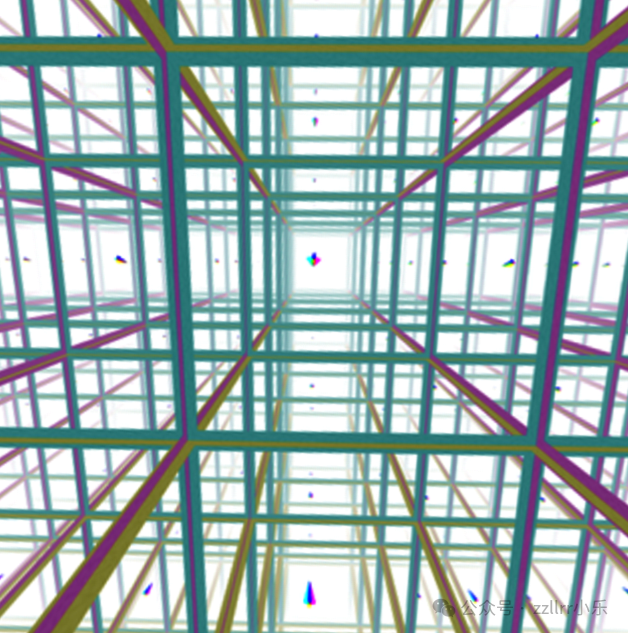
Look around 3 - inside the torus (except the frame is not visible). Each object in the cube appears an infinite number of times because recognition forces the eye to make a full circle in each of the three dimensions.
Image source: Jeff Weeks, from Curved Space Flight Simulator for Multi-Connect Universe https://www.geometrygames.org/CurvedSpaces/index.html, used under the GNU General Public License.
The authors of the PRL article (15 members of the international "COMPACT collaboration") explain that the place to look for information on the topology of the universe is in maps of the Cosmic Microwave Background (CMB). If topology is the explanation for this map's unusual features, then it must contain detectable topological information. The most obvious signs of a topology like a 3-torus are repeated images of features like galaxies, or more generally, what the authors describe as "pairs of circles with matching temperatures (and polarizations)... visible in different parts of the sky", but there are no signs of these.
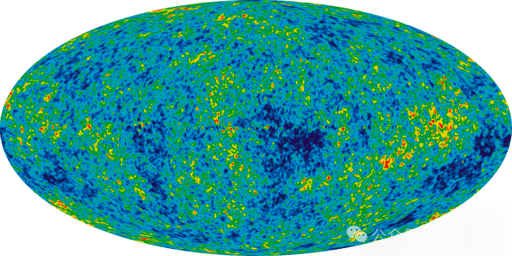
A map of the cosmic background radiation when the universe was approximately 380,000 years old (since the Big Bang). A two-dimensional directional sphere looking outward from the Earth is mapped onto an ellipse.
Image source: NASA/WMAP Science Team https://map.gsfc.nasa.gov/media/121238/index.html
To show that "no matching circles" does not rule out interesting topologies of the universe, the authors investigated several planar models and conditions in which they would not show such circles. They remind us that there are 17 non-equivalent plane possibilities E₁,⋯,E₁₇ and focus on the first three: E₁, a 3-torus, where equivalent faces can be parallelograms or rhombuses; E₂, (where a rhombus face has been rotated by π before being considered equivalent) and E₃ (where a square face has been rotated by π/2 before being considered equivalent). In these examples, they calculated a series of parameters (for example, the relative size of the faces) for which the topology would not show matching circles, so these parameters were still viable candidates for finite universe models.
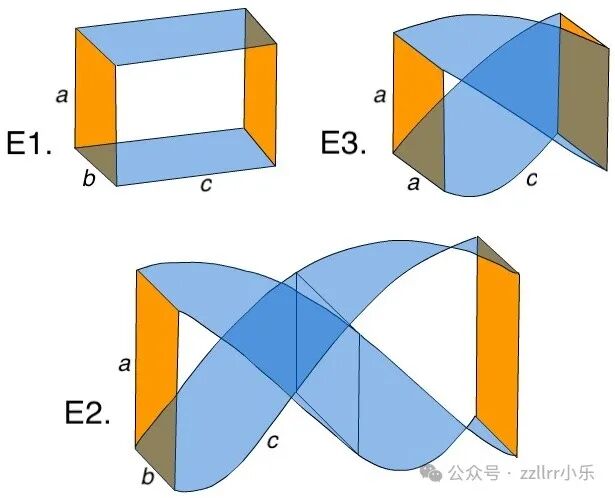
Three flat models. Each is displayed as a 3D solid; when the opposite sides (yellow, blue and transparent) are equivalent, a 3D manifold is defined. The lengths a, b, c are the parameters in the question. For the parallelepiped E₁, this is equivalent to a 3D torus, the same model as shown by Jeff Weeks above. To define E₂, one of the rectangular faces is rotated 180° clockwise before being considered equivalent. The image shows a rectangular cross-section in the middle. In E₃, one of the faces is a square with side length a; it is rotated 90° before being considered equivalent.
Image courtesy of Tony Phillips
|
3. Topology and schizophrenia |
|---|
The application of graph theory in the diagnosis of mental illness was reported in the Schizophrenia Bulletin on April 26, 2024. In the article by Matheus Teles, Jose Omar Maximo, Adrienne Carol Lahti (both at the University of Alabama at Birmingham), and Nina Vanessa Kraguljac (The Ohio State University), Topological perturbations in the functional connectome support deficit/non-deficit distinctions in antipsychotic-naïve psychosis patients https://academic.oup.com/schizophreniabulletin/advance-article/doi/10.1093/schbul/sbae054/7658630 The authors seek physiological support for understanding that deficit syndrome (DS, also known as deficit schizophrenia) is actually a distinct disorder and not just a particularly severe manifestation of schizophrenia. As the name suggests, deficit syndrome https://www.ncbi.nlm.nih.gov/pmc/articles/PMC2559917/ is characterized by persistent negative symptoms such as limited affect, poor speech, and a diminished sense of purpose.
The team worked with 61 patients, 18 with DS and others diagnosed with nondeficient schizophrenia (NDS), comparing them with 72 healthy controls (HC). Their hypothesis is that Down syndrome is special in that it involves a disruption in the brain's functioning connections. To test it, they defined 246 regions of interest in the brain and treated these regions as nodes of the graph. They used functional magnetic resonance imaging to infer the strength of connections between regions by correlating activity between regions, and assigned weights to edges between corresponding nodes based on these strengths. This produces a weighted graph for each subject. Graphs are evaluated using graph theory standards, including:
-
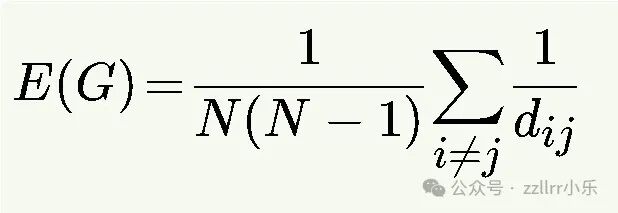
Overall (global) efficiency(Global efficiency). For an unweighted graph, the global efficiency is defined as the average of the reciprocal of the shortest path lengths between any two distinct nodes (so longer paths contribute less). For a connected graph G with N nodes, the shortest path length between node i and node j is dij, and the formula of global efficiency E(G) is
-
global shortest path length(Global shortest path length), here refers to the average length of the shortest path between any two nodes.
-
of node ilocal efficiency(Local efficiency) is the global efficiency E(Gi) of the graph Gi consisting of node i, all nodes directly connected to i, and all edges between them.
-
G'sglobal local efficiency(Global local efficiency) is the average of E(Gi) across all nodes i in G.
Global efficiency, global shortest path length and global local efficiency of 3 graphs
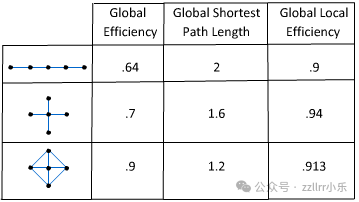
Line 1: The graph consists of 5 nodes connected into a line. The global efficiency is 0.64, the global shortest path length is 2, and the global local efficiency is 0.9.
Row 2: Nodes are connected in a cross shape, with the central node connected to the four surrounding nodes. Compared with straight lines, this graph has higher global efficiency (0.7) and global local efficiency (1.6), as well as smaller global shortest path length (0.94).
Row 3: Cross-shaped diagram, but now the outer nodes are also connected to form a square around the cross. This increases the global efficiency (0.9) and reduces the global shortest path length (1.2), but the global local efficiency (0.913) is lower than that of the cross.
Examples of three measurements for three small unweighted plots.
Image courtesy of Tony Phillips
The results showed that there were statistically significant differences in global efficiency, global shortest path length, and global local efficiency between the deficit syndrome group and the other groups. (In their conclusion, the authors noted that topological metrics showed no statistically significant differences between control and NDS (non-deficit syndrome schizophrenia) subjects. Taken together, this proves that deficiency syndrome is indeed a distinct disorder.)
|
References |
|---|
https://www.chemistryworld.com/opinion/making-sense-of-the-maths/4019357.article
https://wmap.gsfc.nasa.gov/universe/uni_shape.html
https://journals.aps.org/prl/pdf/10.1103/PhysRevLett.132.171501
https://physics.aps.org/articles/v17/74
https://www.geometrygames.org/CurvedSpaces/index.html
https://map.gsfc.nasa.gov/media/121238/index.html
https://academic.oup.com/schizophreniabulletin/advance-article/doi/10.1093/schbul/sbae054/7658630
https://www.ncbi.nlm.nih.gov/pmc/articles/PMC2559917/
Xiaole Mathematics Popular Science: Professor Tony Phillips’s Mathematics Newspaper Review 2024-02
Xiaole Mathematics Popular Science: Professor Tony Phillips’s Mathematics Newspaper Review 2023-11
Xiaole Mathematics Popular Science: Professor Tony Phillips’s Mathematics Newspaper Review 2023-10
Xiaole Mathematics Popular Science: Professor Tony Phillips’s Mathematics Newspaper Review 2023-05
Xiaole Mathematics Popular Science: Professor Tony Phillips’s Mathematics Newspaper Review 2023-04
Xiaole Mathematics Popular Science: Professor Tony Phillips’s Mathematics Newspaper Review 2023-03
Xiaole Mathematics Popular Science: Professor Tony Phillips’s Mathematics Newspaper Review 2023-02
Xiaole Mathematics Popular Science: Professor Tony Phillips’s Mathematics Newspaper Review 2023-01
|
Recent articles |
|---|
· Open · Friendly · Diverse · Universal · Clumsy · Make mathematics easier to learn, practice, teach, research, appreciate, play, see and obtain
Easy to spread and easy to reach
Machine-translated from the Chinese original 小乐数学科普:Tony Phillips教授的数学读报评论2024-04 (published 2024-06-05). WeChat original ↗