In the 1830s, the British physicist Faraday discovered the phenomenon of electromagnetic induction and found a way to generate electricity through magnetism. When he demonstrated this experiment at a lecture at the Royal Institution, a lady in the audience asked: "But sir, after all, what is the use of this thing?"
Faraday said: "Excuse me, madam, after all, what is the use of a newborn baby?"
This rhetorical question is quite refreshing. When we look at this story almost two hundred years later, and think about Faraday's inventions that no one can do without - generators and electric motors, we will feel that this answer is a very powerful irony.
Unfortunately, this is just a joke, at least not from a historical record. The true situation back then is no longer known, but the cruel stories are happening now.
In the summer of 2024, a book called "The Poetry of Order: Flowers, Architecture, Escher" will be released on the library. As the editor of the book, I invited a friend who specializes in book marketing to a coffee shop. Just as I was wagging my lips and voicing lotus flowers, the other party asked my soul: "But Teacher Yang, after all, who needs this book?"
"Math lovers!"
"Mathematics lovers like mathematics, and they may also like order, but why do they need a book related to art? It also has 'poetry' in the name?"
"Uh...art lovers then!"
"What art lovers like is art and beauty. Do you think they will like mathematics and order?"
emmmmm……
It seemed that my skills were still a little worse than Faraday's. I didn't have any quick wits at that moment, so I had to close the computer silently, feeling a burst of resentment in my heart. This emotion is not directed at the friend opposite me, but is directed at someone else. I really want to seriously ask the author of this book, Zhang Yi:
You, a person who clearly knows that mathematics and art can meet your immediate needs, why bother writing a book that cannot satisfy your immediate needs?
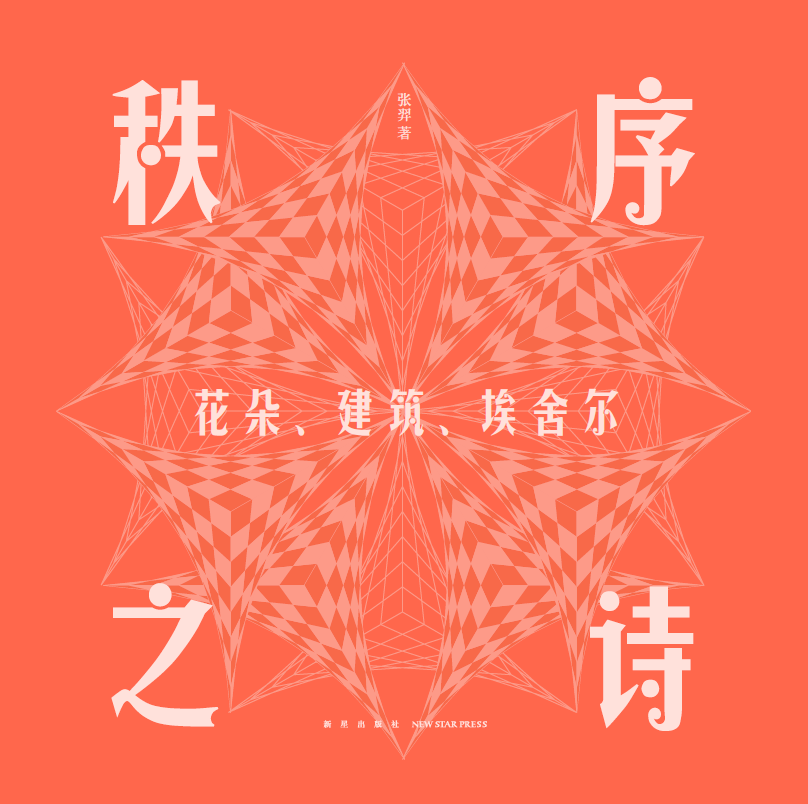
Cover of "The Poetry of Order: Flowers, Architecture, Escher"
Click on the image above to get this new book
A person who knows that mathematics and art are useful
Zhang Yi, male, was born in Tianjin in 1988.
This person's profile has a lot of quotes. When he was working, he was a programmer, a translator, and an illustrator, and now he also added the label of "writer" - "The Poetry of Order" is Zhang Yi's first original work. Although it is mainly pictures, the pure text also has 120,000 words. In life, he is a lover of mathematics, art, science, science fiction, and A-shares - such a list makes people wonder whether a person with such widely dispersed interests still has a life.
As a translator, he is keen on translating popular science and science fiction works. Many people will surely find familiar words in the following book titles: "Synchrony: How Order Emerges from Chaos", "How Intelligent Machines Think", "The Rebirth of AI", "The Transhuman Code", "Feed", "Mirror Shadow", "Why Data Lies", "How to Think Thinking Machines", "Stealing Stars", "Real Names", "Galaxy Edge" (003-007)...
(Yang Dun: Please don’t delete the new media editor. This paragraph is not to bring goods to colleagues, but to attract traffic for new books; Teacher Zuo from the Nantong Reading Base of Reading Library can come forward to testify. Teacher Zhang Yi’s translations still have a good reputation)
(New media editor: Let’s delete it)
As a programmer, Zhang Yi can be said to rely on mathematics for a living. This is not an exaggeration. He is engaged in software development in a medical device company and is indeed inseparable from mathematics. He is immersed in or wading through various mathematical algorithms every day, using code to complete or delay tasks assigned by his boss. In his spare time, as an enthusiast of both A-shares and mathematics, he has long been committed to "academic research" in this cross-field. Although he has no published papers, his bank account knows his results: in the face of unpredictable stock trends, he uses various mathematical models to analyze and predict, and he has won countless big red candles on the K-line chart. What is particularly annoying is that even in the A-share market in 2023, he actually made gains.
It can be said that he is a person who has truly experienced the "usefulness" of mathematics.
As an illustrator and art enthusiast, and a former key training target of the Tianjin Children's Palace Art Class, he can not only write code, but also draw the operating interface of electronic medical equipment. Of course, he doesn't paint with a brush, but with a computer, or in multiple senses: with mathematics. Just like the various mathematical artistic creations shown in "Poetry of Order", with the help of mathematical software, the combination of mathematics and art is achieved by setting various parameters.
So it can be said that he is a person who has truly experienced the "usefulness" of art.
For such a person, it is not difficult to guess that he should have done well in mathematics when he was a child. Indeed, his admission to Tianjin University was largely due to his excellent mathematics scores. But he didn't like mathematics at that time, at least not as a hobby. The endless practice of answering questions soon bored him, and he lost interest in free exploration. When I had the opportunity to choose my choice, I had no hesitation at all, so I avoided mathematics and studied electronic engineering. Even after many years, when he had greatly improved his work performance and enriched his wallet balance with the help of mathematics, he still believed that he had never entered the door of mathematics - getting high scores, typing some codes, and making a little money were just trivial skills that were difficult to enter the palace of mathematics.
Until he met Escher.
It is also not difficult to imagine that Zhang Yi must have had some artistic talent when he was a child. He begged his family to sign up for an art interest class. Unfortunately, he gradually lost interest in the pencil in his hand as he traced plaster geometry and heads day after day. From then on, art became an unattainable and sacred place in his eyes, and the boring creative process and finicky expressions of traditional painting were enough to keep him at a distance.
Until he met Escher.
It was in an old bookstore that Zhang Yi met the famous Dutch artist Escher by chance: "Those works with great visual impact and full of mathematical charm immediately attracted me... It turns out that painting and mathematics are not far apart. The beauty of mathematics can not only be presented through profound formulas, but visual art can also show the charm of reason." - Now everyone knows why "Escher" is included in the subtitle of "The Poetry of Order".
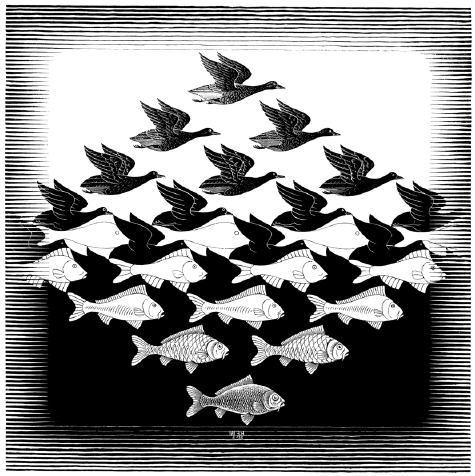
Escher woodcut "Sky and Water I"
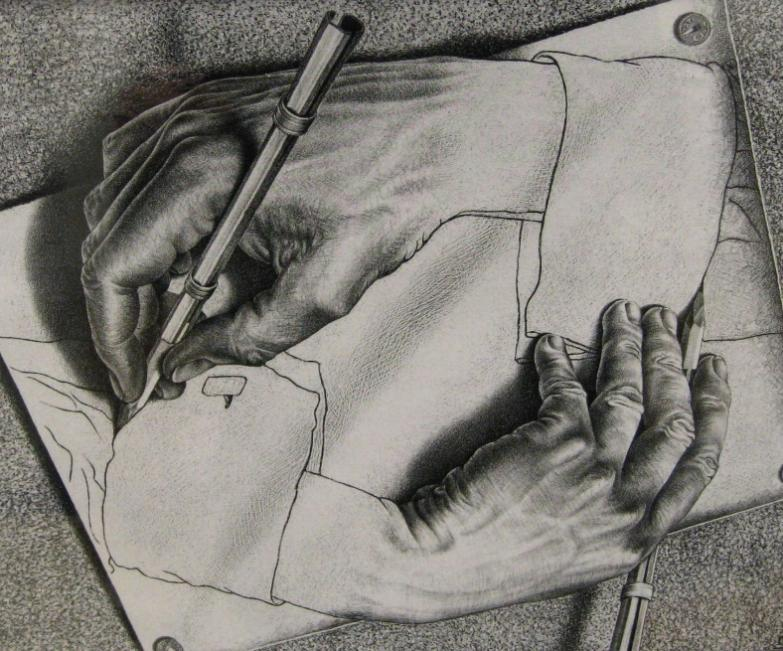
Escher oil painting "Hand Painted Hand"
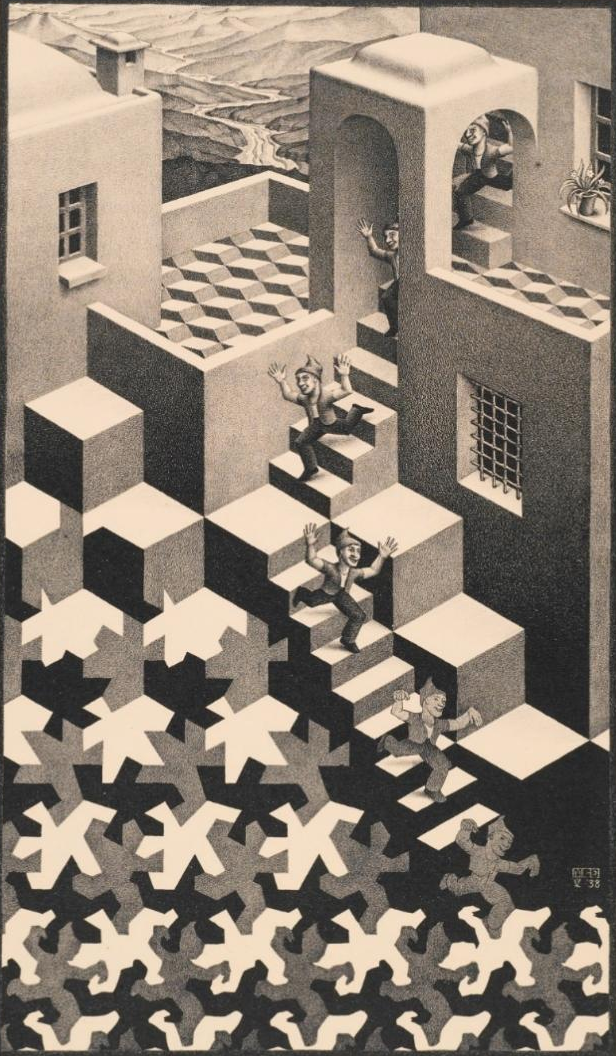
Escher print "Cycle"
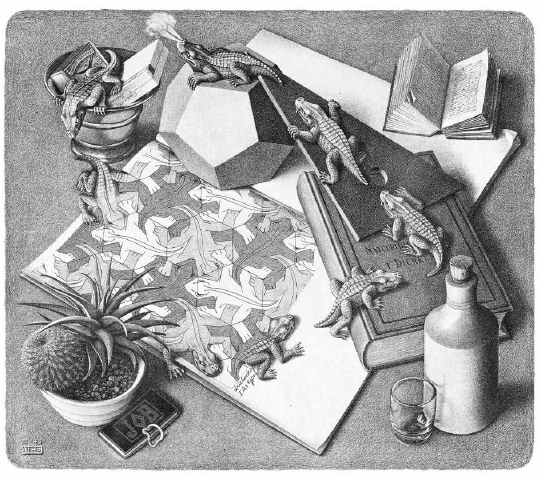
Escher lithograph "American Crocodile"
(Yang Dun: Please present the above four paintings separately to show the details)
(New Media Editor: Done)
Facing a genius like Escher, Zhang Yi, besides admiring and admiring him, couldn't help but be itching to see the talented person. His feelings for art and mathematics were reactivated, and he began to use computers to create various "works with great visual impact and full of mathematical charm" and published them on his public account "Cosmic Civilization Leading Party".
This is how "Poetry of Order" came about.
Chapter 3 of this book is called "The Poetry of Reciprocity: Symmetry", and section 8 is called "Do Programmers Understand Art?" and the content is about "The Application of Antisymmetry in Decorative Art." When I was frowning in the coffee shop, I really wanted to ask Teacher Zhang Yi: Why don't you write about "Application of antisymmetric algorithm in A-share K-line chart"?
Chapter 6 of this book is called "The Poetry of Iteration: Fractal" and section 4 is called "God's Fingerprint". The theme is actually "Chaos and Order in Rabbit Reproduction". I also want to ask Teacher Zhang Yi: Why can’t you write about “Chaos and Order in the A-share Market”?
After thinking about it, I felt that there was no other possibility - there must be someone who had already become rich and chose revenge.
A book that makes mathematics and art seem useless
On the Douban page, the introduction I wrote for "Poetry of Order" is: This is a cross-disciplinary work that wanders between mathematics and art. It aims to scan various natural creations and artistic creations with a pair of "mathematical eyes" and analyze the hidden order behind the beauty and poetry.
This is telling the truth, and I have tried my best to restrain my motivation for self-praise, but I must admit that the friend who bought me a cup of coffee and then disappeared is also telling the truth: in today's environment, who would be willing to open such a book that "walks between mathematics and art" rather than "caters to rigid needs" or "caters to emotions" or "brings its own topics" and "brings its own flow"?
Math lover?
First of all, it should be noted that under the multiple education of universities, middle schools, primary schools, educational institutions and social reality, not many mathematics enthusiasts can survive - the early experience of the author of this book is evidence. Even after a narrow escape, there are really a few people who still have a passion for mathematics. Why do they use their brains on topics related to beauty and art?
Is it because the author discovered the order of beauty and the beauty of order in the following heavenly objects and works of art?
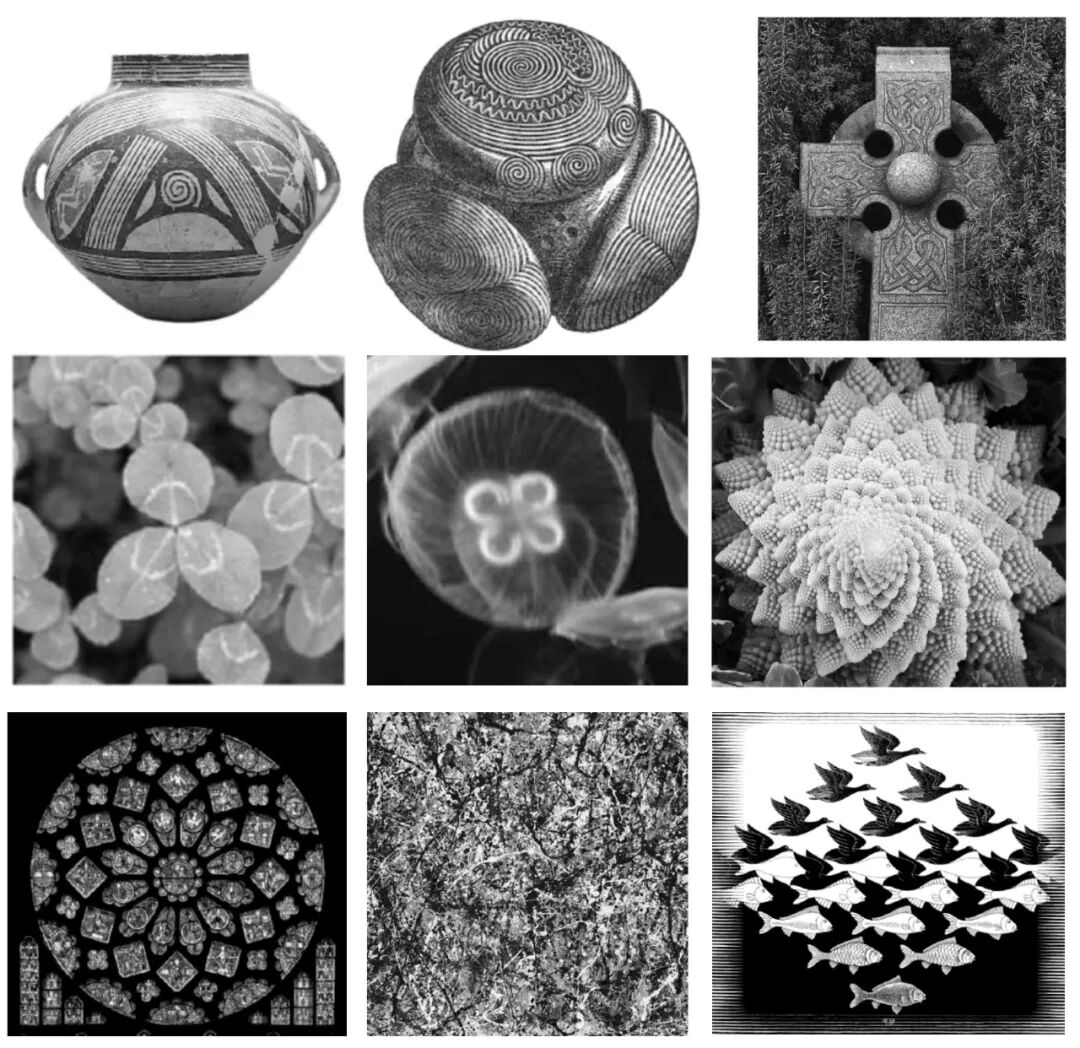
Top left to bottom right: Greek clay pots, Scottish stone balls, Celtic crosses, white clover, jellyfish, cauliflower, church windows, Pollock drip paintings, Escher prints
(Yang Dun: Please ask the new media editor to make a nine-square grid picture based on the illustrations in the book. If there is a more suitable text picture, you can change it)
(New media editor: I won’t change it anymore, let’s just leave it like this)
From blades of grass to flowers, from embroidery patterns to architectural window panes, from Escher to Pollock, all have a pleasing and intoxicating beauty, and all contain pure and simple mathematical order. Does order produce beauty, or does beauty include order? With 400 pictures and 120,000 words, this book raises questions and expects readers to give their own answers.
However, it must be noted that "The Poetry of Order" does not conduct a comprehensive and in-depth discussion on the grand theme of "mathematics and art". Instead, it only selects a small number of topics and strives to analyze them in a subtle and detailed manner, creating a window for readers to peep into and a door for entry. This leaves another question that requires readers to answer: Can such a book be discerned by serious mathematics enthusiasts? Can it inspire readers who are really willing to think seriously?
It's possible. It's even possible. But it's only possible.
So, what about “mathphobes”?
This is a huge group.
However, since they suffer from mathematics phobia, they must have suffered from mathematics, and they may have avoided mathematics like snakes and scorpions. Why would they need a book related to mathematics?
Copywriting is of course easy to deal with, just write one sentence: Guests, please go slowly, this book is a panacea for math phobia.
But why? The author also suffered from math phobia and later regained his interest in mathematics? In fact, Teacher Zhang Yi was not considered a phobia of mathematics at that time, but was at best a misanthrope of mathematics. And before he was completely indifferent to mathematics, he must have felt the beauty of mathematics at many certain moments.
Well, this book seems to be really good.
After all, everyone has experienced the age of innocence. Before being deprived of the joy of thinking by various tortures, everyone has enjoyed the beauty and wonder of mathematics. If you really have such a reader, and you estimate that you can tolerate having a friend beside you who is chattering away to help you with math, or even drawing schematic diagrams on a napkin while drinking coffee, then this book is really good.
Let’s take an example related to coffee and see how the author did it.
Probably because he disliked his poor skills, Teacher Zhang Yi first chose a coffee photo taken by others. This was to show the heart-shaped line on the surface of the coffee. He also probably wanted to show that this moving heart-shaped line actually exists in real life:
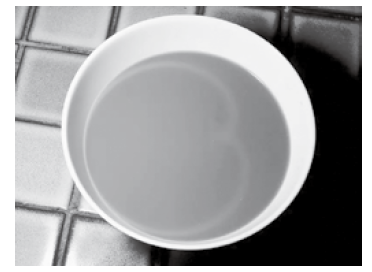
Heart shaped line in coffee cup
Next, Teacher Zhang opened the topic: "Of course this is not because the barista's math level has caught up with the Spider King, but it has something to do with the shape of the cup." The reason why he mentioned "Spider King" is because in the book "Poetry of Order", the entire section about heart-shaped lines and kidney-shaped lines starts from spiders building webs.
"If you look more closely, you may realize that the heart-shaped line here is actually the envelope of light. Just like using a magnifying glass to focus light, the denser the light, the brighter it looks. Every point on the heart-shaped line on the surface of the coffee is a place where the light reflected by the cup wall is dense."
At this time, Teacher Zhang is more like a teacher, because he has to give a "three-minute junior high school physics class." The core of this lesson is to explain why the light emitted by a point light source forms a heart-shaped line after being reflected by the wall of the circular cup. There are pictures and the truth:
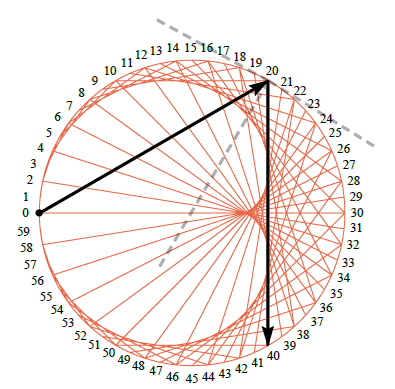
The formation of the inner contour of the coffee cup
With such an analysis, I don't believe anyone will be afraid of the mathematical problems involved. It is very possible to say that I find it interesting, or even be shocked by both beauty and rationality.
But Teacher Zhang was not satisfied. After explaining the heart-shaped line, he changed the point light source to a parallel light source such as sunlight, so similar reflections would form a new envelope line - this was the transition from the heart-shaped line to the kidney-shaped line.
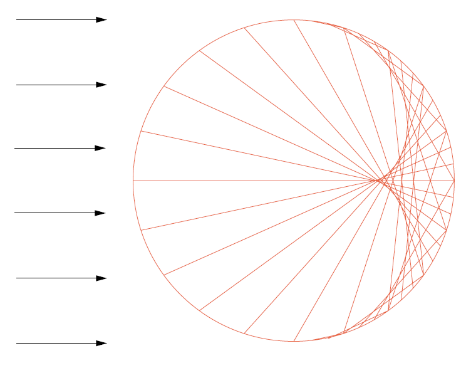
Constructing a half-kidney line using light envelopes
The name of the kidney-shaped line and the appearance of the shape "seem not as romantic as the heart-shaped line." (New media editor: It’s not romantic, this looks like a shiny butt) but the author soon demonstrates that mathematicians have even less romantic graphs out there. By slightly changing the conditions, more shapes can be formed:
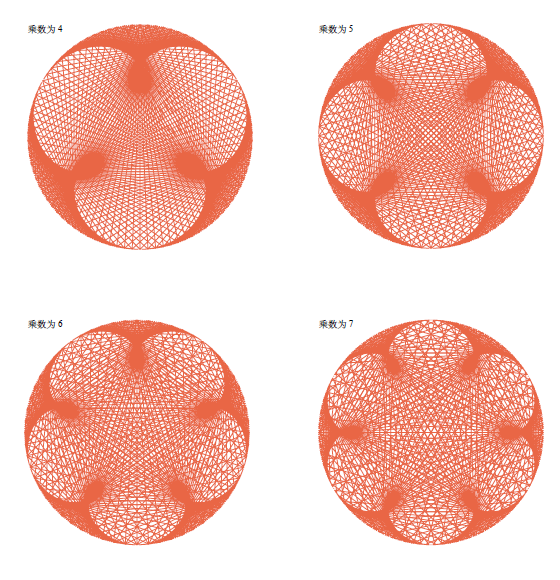
These graphics seem to have nothing to do with romance, but each is more profound and more beautiful than the last. Looking at it from another angle, this has simply become the most romantic thing. (New Media Editor: Okay)
In this way, the author used four pages in the book to tell the story:
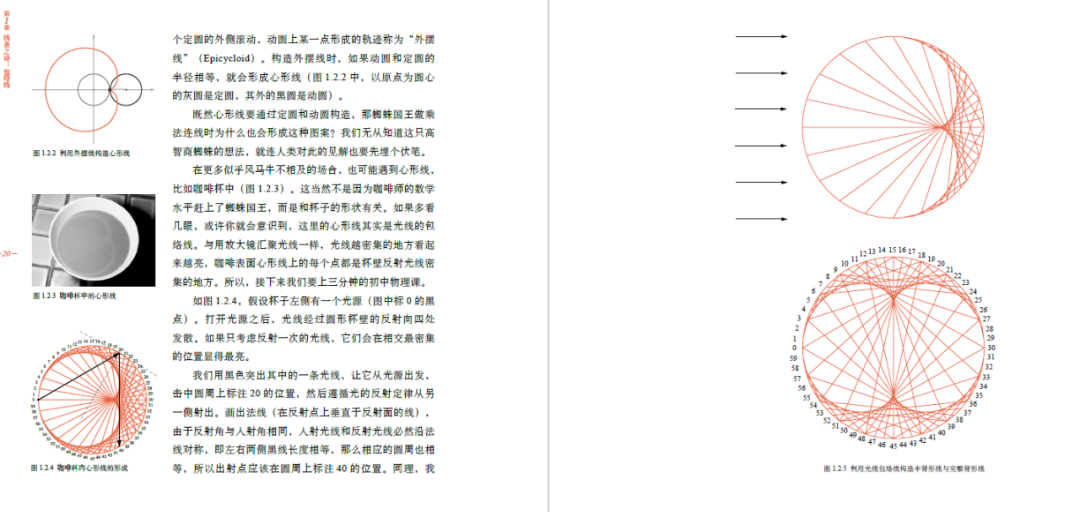
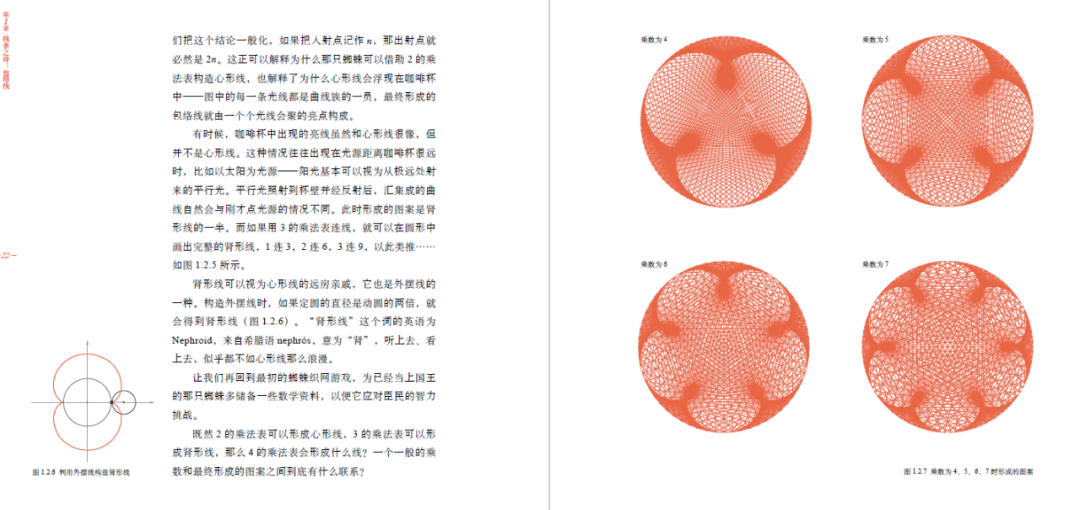
This is a typical passage in "The Poetry of Order", which shows the real beauty in life and analyzes the mathematical order contained in this beauty. It shows the poetry brought by order and uses order to write new poems. As for the question that runs throughout the book, whether order produces beauty, or beauty includes order, there is still no answer. The author obviously thinks a lot about order and beauty, but leaves more thinking to the readers.
Similar passages abound in the book. It can even be said that the author has been doing the same thing, just constantly changing the subject and renovating the way of telling:
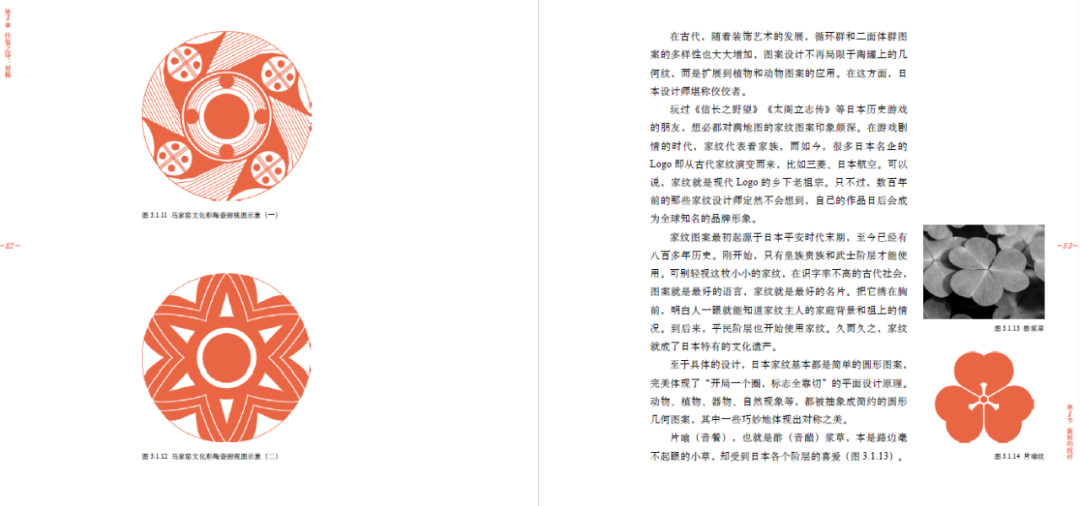
This is an analysis of symmetrical figures in painted pottery and flowers and leaves.
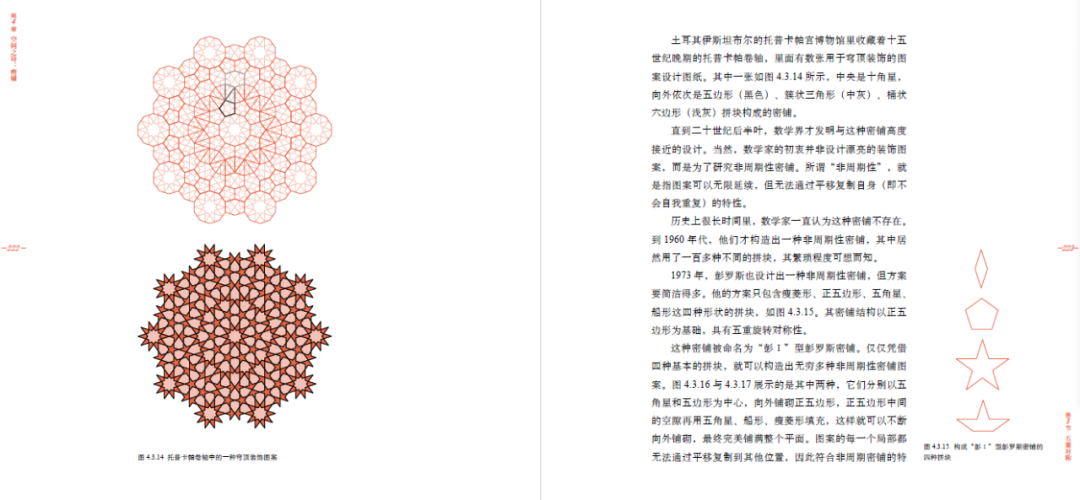
This is a comparison of ancient and modern non-periodic paving.
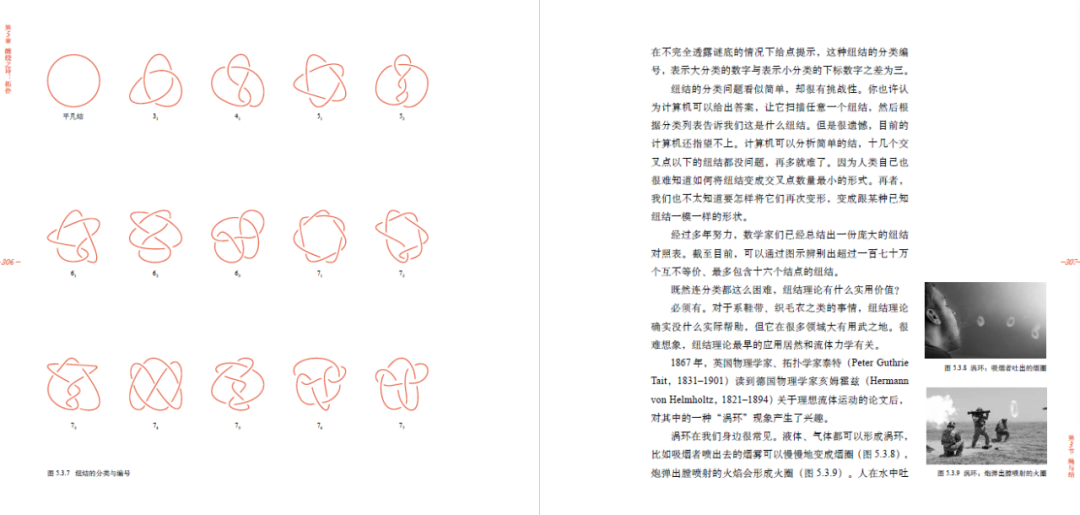
This is showing the topology of the knot
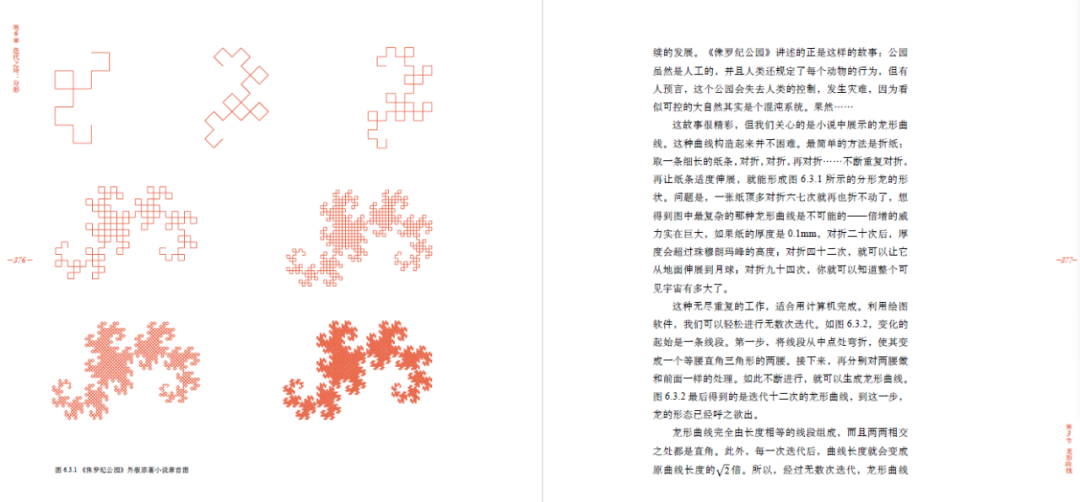
This is building the dragon curve in Jurassic Park
The analysis of "The Poetry of Order" revolves around six major mathematical themes such as envelopes, spirals, symmetry, tessellation, topology, and fractals. Each chapter is also named after a mathematical topic. This can imply the author's writing intention, "to re-observe and think about art from a mathematical perspective" rather than examining mathematics from an artistic perspective. So in the final analysis, this is still a mathematics book, but it limits the subject to the fields of art and beauty.
After breaking it apart and crumbling it, let everyone feel the beauty and truly understand the mathematical principles, and then knead it together to create something new. It is difficult to say that this way of writing can definitely cure the phobia of mathematics, but perhaps it can at least make us feel the fun of mathematics again.
Maybe, even quite likely, but just maybe.
Let’s look at art lovers
Do art lovers need proof if they like this book? Just show them the mathematical artwork created by the author:
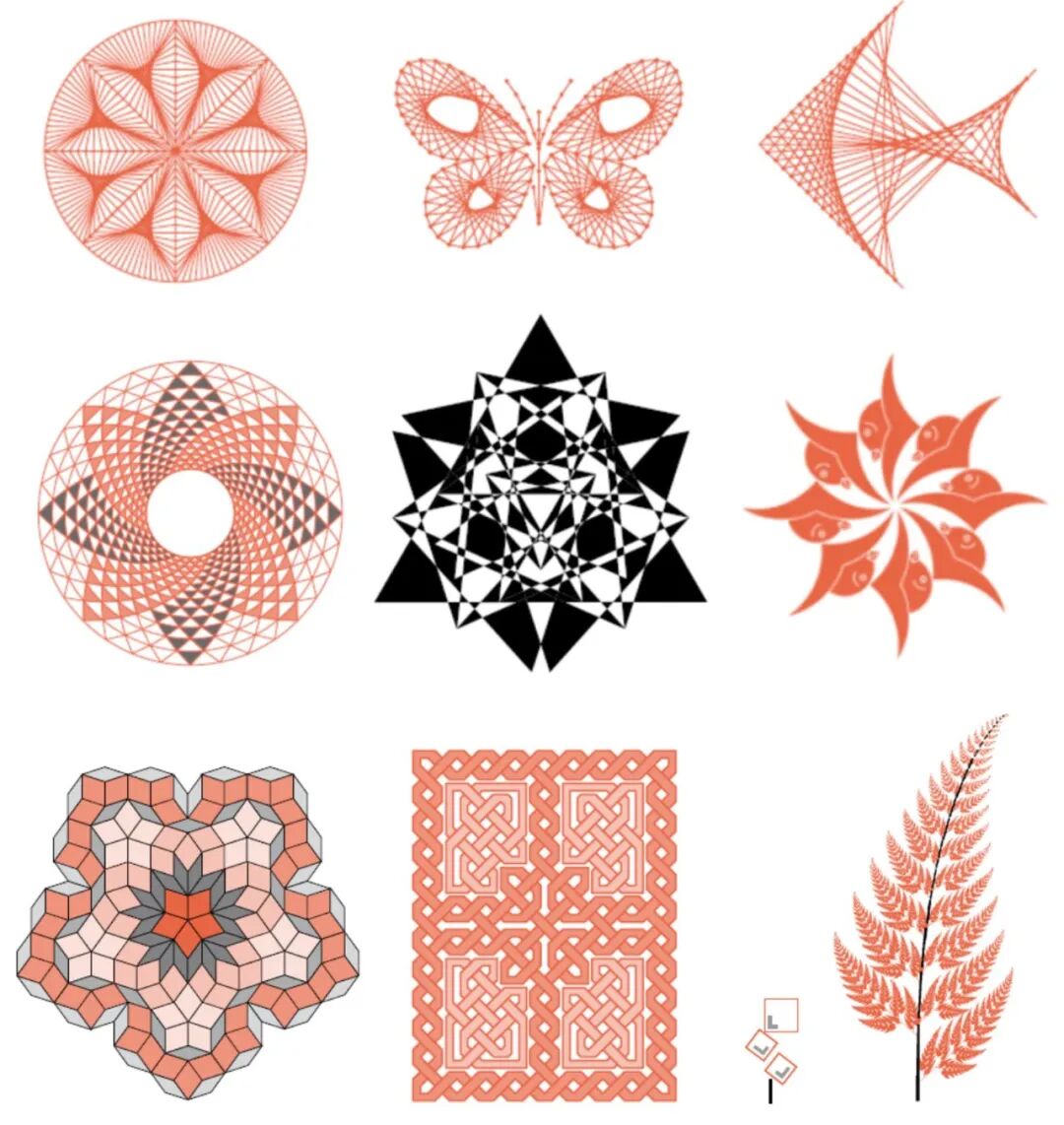
Top left to bottom right: three mathematical embroidery works by the author, Corinthian mosaic, five-fold symmetrical structure, Japanese wild goose pattern, "PengⅢ" type Penrose paving, knot decorative patterns, fractal ferns
(Yang Dun: Please arrange the nine pictures above in a nine-square grid)
(New media editor:Yeah)
However - there are always many things in life. Such creations may impress art lovers, but why should people understand the mathematical principles behind them? After all, in the eyes of many people, art is fundamentally for perception, not for understanding.
If someone agrees with this view, he will definitely agree with the British poet Keats's harsh criticism of Newton. Newton completed the dispersion experiment of sunlight and explained the principle of rainbow based on it. Keats, who came to this world more than a hundred years after Newton, instead of thanking Newton for helping the entire human race expand the boundaries of thinking, Keats strongly criticized Newton for destroying the poetry of the rainbow.
Keats is a famous Romantic poet, and his views are not completely unreasonable. Perhaps they can only be refuted by the views of the famous American physicist Feynman.
Feynman had an artist friend who said to him one day: "Look, how beautiful these flowers are!" Feynman said that he also thought they were beautiful. The artist went on to say: "But you are a scientist, and you can only professionally analyze this flower layer by layer. This is too boring." Feynman's answer was simply: "You are talking nonsense. Scientific knowledge can exactly increase the beauty and mystery of flowers. After understanding this knowledge, people will be more interested in flowers, and it will be harder to stop admiring them."
It should be noted here that the subtitle of "Poem of Order" begins with "Flowers".
If Keats and Feynman had the opportunity to debate face to face, the author of this book, Zhang Yi, should be more supportive of Feynman. In Section 6 of Chapter 4 of "The Poetry of Space: Paving" in "The Poetry of Order", after constantly changing graphics and analyzing Escher's optical illusion art, the author writes: "Knowing that this is a gift from the eyes and nervous system, we are still obsessed with this kind of deception, just like knowing clearly the mathematical principles of Islamic decorative patterns and Escher's paintings, we still feel that they have incredible beauty."
Perhaps to take care of Keats's feelings, Teacher Zhang Yi added another sentence: "Perhaps it must be admitted that many times what people need is not explanations, but feelings."
Art professionals must have their own understanding of what beauty is, and how to appreciate and perceive beauty. Even so, this book may bring some inspiration and may even provide a new path worth exploring.
At least maybe, just maybe.
How about taking care of patients with "aesthetic blindness"?
Discerning readers should have seen through my trick a long time ago: this article seems to be seriously discussing the target readers of "The Poetry of Order", but in fact it is establishing a framework and trying to pack more praise words into it. At this point in writing, the reason why I admit all this so frankly is not out of true honesty, but because I really can't pretend anymore.
The term "aesthetic blindness" is very common, but it is difficult to believe that true beauty blindness exists in this world. Those who claim to be so, if not self-effacing, are simply not satisfied with their aesthetic or perceptual abilities. Don’t forget, before meeting Escher, the author of this book would probably have held such a title for himself, but now who dares to say that this person was once a beauty blind person?
Everyone can feel beauty, and can definitely understand beauty to a certain extent, as long as he can meet the right window, preferably a suitable door, at the right time. Zhang Yi met Escher in a used bookstore, and this "Poetry of Order: Flowers, Architecture, Escher", if placed on a new bookshelf or in a used bookstore, may also become the Escher of many readers - wait a minute, is this why a person who knows that mathematics and art are useful would write such a book that makes mathematics and art seem useless?
If someone disagrees with my assertion and firmly believes that he is beauty blind, please allow me to use the following six pictures to test:
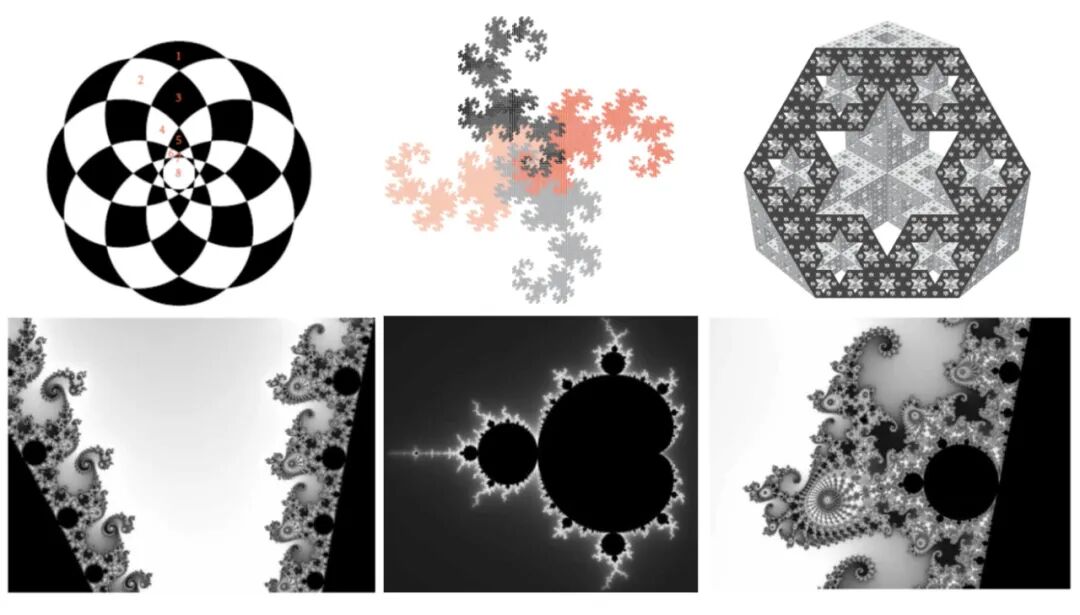
From upper left to lower right: three pictures of symmetric difference sets, dragon curves, Menger sponge sections, and parts of the Mandelbrot set
(Yang Dun: Please arrange the above six pictures into a nine-square grid)
(New media editor:How to arrange six pictures into a nine-square grid?)
(Yang Dun: How many knives can cut six apples into nine pieces?)
Regardless of whether these graphics are the creations of artists or the work of mathematicians, when faced with such objects, do you think they are beautiful or ugly, or are you completely indifferent? Do you find them interesting, boring, or completely baffling?(New media editor: I think you are boring and inexplicable)
If it feels good, then don’t worry, your perception of beauty and order is absolutely normal, at least similar to the author and many people; if your feelings are all negative words, you don’t have to say that you are beauty blind, it may just be because their beauty has not reached your threshold.
Under such clever words, even if you still think that you are unable to feel beauty, or even do not need to feel beauty, I am afraid it will not stop me from recommending this book: then treat "The Poetry of Order" as a purely mathematical book. Perhaps after your mathematical skills have greatly improved, your aesthetic ability will come quietly.(New Media Editor: What you say is a bit irritating)
In a beautiful village, wait for the wind to come and wait for people to come
"When the wind of mathematics blows through the beautiful village", that is exactly the scene that this book wants to present. Now, the author and some readers have gathered in the village of Midea, waiting for the wind of mathematics to blow, and for more readers of various models to arrive.
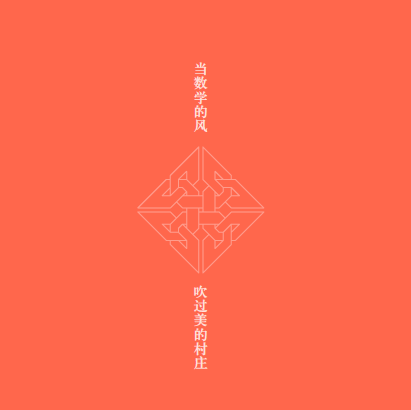
Back cover of "The Poetry of Order: Flowers, Architecture, Escher"
You can also buy this new book by clicking on the image above
Mathematics lovers, math phobias, art lovers, and beauty blindness are just simple and crude labels, and a large number of labels are made into self-adhesive labels, just waiting to be torn off. So don’t care too much about the labels on yourself, let alone the discussions in this article based on these labels, which are just showing off advertising skills.
(New media editor: Teacher Yang, I think this paragraph can be deleted)
(Yang Dun: No)
(New Media Editor: Good ones have been deleted)
(Yang Dun: I said don’t delete it...)
Including "Poetry of Order", there is no book that must be read, and there is no book that must not be read; don't make things difficult for yourself, and don't let yourself go easily.
This is not a practical book, but some people will definitely regard it as food and vegetables; this is not an emotional book, but some people will be emotionally touched; the topic of "mathematics and art" is not topical, but some people will definitely include it in heart-to-heart communication, intellectual and intellectual dialogue.
Regardless of the author or the editor, we really don’t know exactly which readers the so-called “someone” just refers to, and we are not even sure what the core readership of this book is. Of course, this is more limited to our abilities and is not intended to highlight how extraordinary this book is.
However - there are always many things in life -
The author still chose to write this book, even if he had to sacrifice a lot of time tinkering with K-line charts to make money; the publishing agency "Line Space Culture", which was rapidly accumulating reputation, still chose to recommend this book to Duku, even though Duku did not even promise a guaranteed minimum printing quantity; and Duku still chose to write this book and put it in front of readers, even if the process was bumpy and the progress was delayed again and again.(Lao Liu: Read.)
For us, the attitude is the same: there is no book that must be done, and there is no book that must not be done; we do not make it difficult for ourselves, and we do not let ourselves go easily.
In fact, every time we send out new book promotion information
No matter how many pictures you put, add links and prompts
It will attract some enthusiastic readers and friends to leave messages and ask frantically:
"Where can I buy this book?"
In response to this, the Xiaoliu people shouted crazily and politely but depressedly:
"You can buy it by clicking on the picture below!"

This is the dividing line that marks the end of the text.
……
New media editor:Teacher Yang, I think your last few nonsense sentences are particularly well written. It seems like it didn't say anything, and in fact it didn't say anything, but it suddenly became valuable.
Yangton:The previous nonsense was not well written?
New media editor:It's pretty good... Some readers saw this and said, hey, why don't you let the author of this book, Mr. Zhang Yi, come out and say a few words? Just look at the editor beeping here.
Yangton:We have already considered this issue, so we made a special trip to Tianjin, the hometown of Teacher Zhang Yi, to conduct an exclusive interview with him.
New media editor:We are quite far from Beijing... Since the content of this exclusive interview is too blatant, we will not release it today to avoid blatant remarks.
Yangton:Readers, please look forward to the next exciting release of Duku Public Account.
New media editor:Please look forward to the appearance of the mysterious man Teacher Zhang Yi who is inconvenient to sacrifice himself. See you next time.
The author of this article is also the editor and planner of this book | Yang Dun
New media editor who is inconvenient to sign | Lao Wu
This is the dividing line that indicates the end of the easter egg.
……
Who would have thought that there are advertisements underneath the easter eggs?
Liu Bo
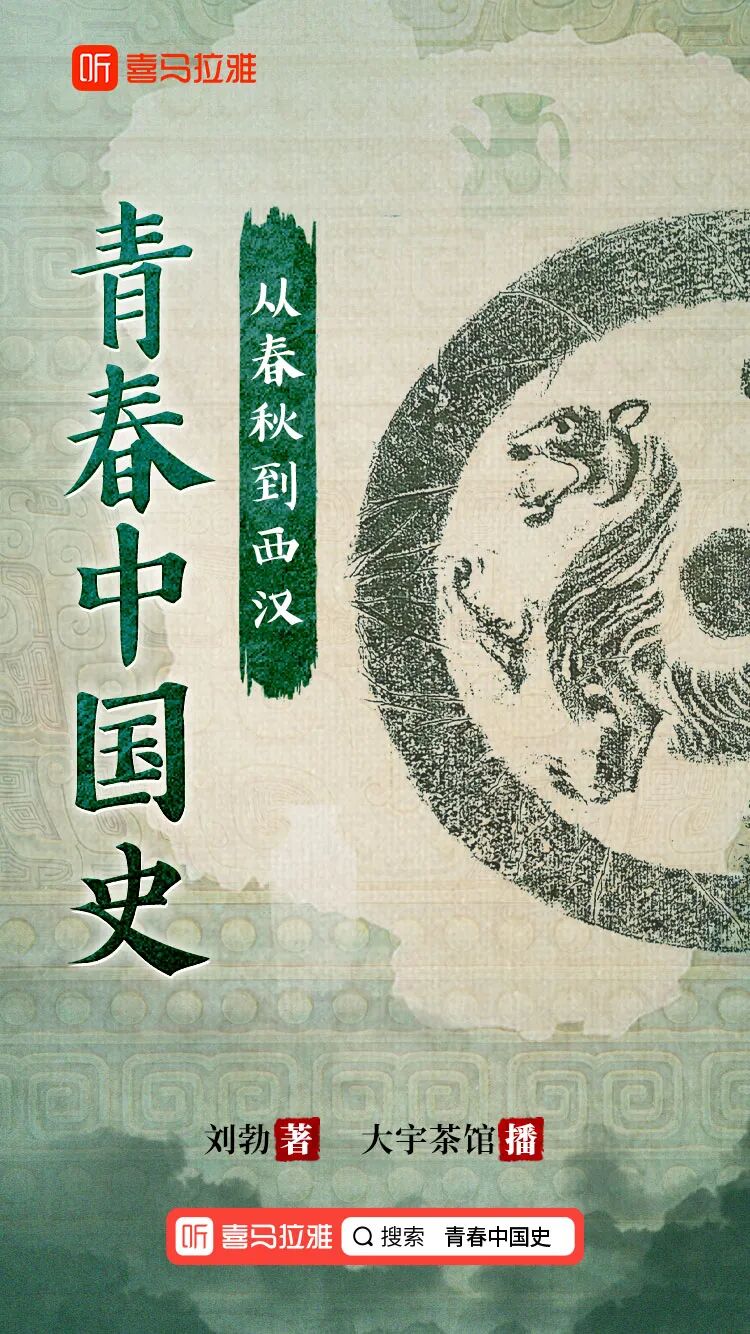
"History of Youthful China"
Himalayas
Youthful Chinese History
"The Age of Losers"
"The Wrong Path of the Warring States Period"
"Gourd"
"Sima Qian's Field of Memory"
Click on the image below to purchase the "History of Youthful China" tetralogy

Machine-translated from the Chinese original 但是说到底,谁会需要这本书呢? (published 2024-07-04). WeChat original ↗