Introduction

The essence of investment target screening is to establish a verification chain between the company's self-report and objective facts.
As the openness of public data continues to increase, government data sources such as industry and commerce, taxation, patents, bidding, land, human resources and social security have become a "second perspective" that cannot be ignored by funds when evaluating targets. But the question is - what should we check for a specific company? What to check first? What data dimensions do the investment preferences of different funds correspond to?
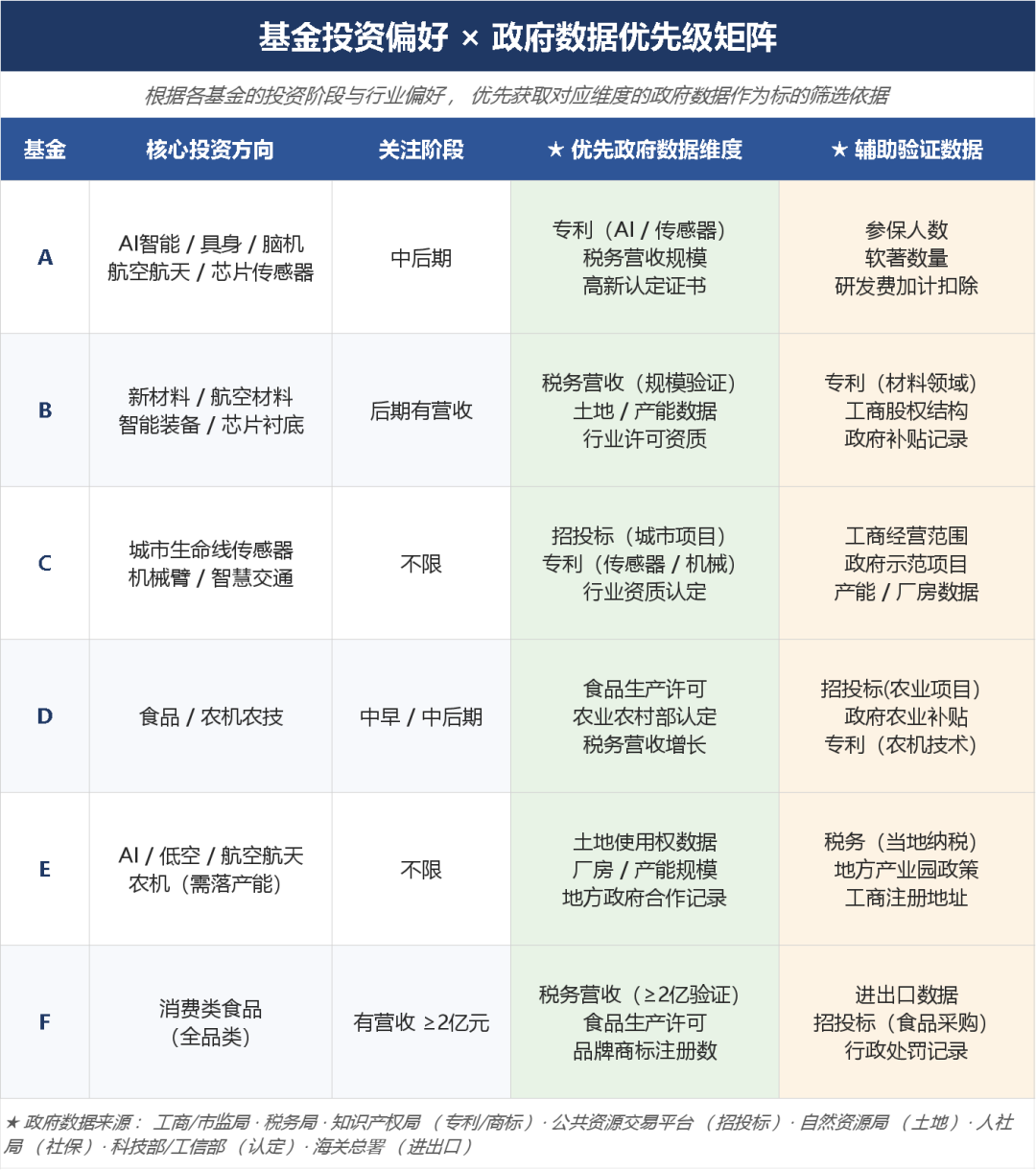
We have systematically aligned the 6-dimensional corporate communication framework of the OPC Super Innovation Camp "Data Lab" with government public data, and sorted out a data priority matrix based on the investment stage and industry preferences of the cooperation funds.
Below is the complete template.

1. Basic situation of the enterprise
OPC correspondence: company positioning · core business · existing results · team advantages
01 · What the company needs to display
Positioning in one sentence:
-
Focus areas (industry + technical direction);
-
Target customer groups and market positioning;
-
Data/technology related core competencies.
Core business and existing results:
-
Main products or services;
-
Number of customers/number of users/scale of revenue;
-
Typical cases or cooperative customers.
Team and technical advantages:
-
Core member background (industry + technology);
-
R&D team size and distribution;
-
Data processing/AI/engineering capabilities.
02 · Government data sources (can be pre-checked and verified)
Industrial and Commercial Registration Data (Municipal Supervision Bureau):
-
Business scope → Business positioning verification;
-
Registered capital/paid-in capital → shareholder strength;
-
Years of establishment → Judgment of development stage.
Tax/Tax Data:
-
Annual revenue/VAT scale → stage matching;
-
Tax Credit Rating → Financial Health;
-
Growth rate in the past three years → Growth judgment.
Social security/human resources and social security data + certification:
-
Number of insured → Actual size of the team;
-
High-tech enterprise/specialized new certificate;
-
Recognized by the Ministry of Science and Technology as a technology-based small and medium-sized enterprise.
*Related funds: F (revenue ≥ 200 million) · B (with revenue scale) · A (mid-to-late stage)

2. Business scenarios and pain points
OPC correspondence: Specific business scenario description · Current pain points · Data gaps
01 · What the company needs to display
Specific business scenarios:
-
Industry and application scenarios (such as regional market analysis, supply chain optimization, risk control scoring);
-
At which stage external data support is needed;
-
Core business process pain points.
Data acquisition status:
-
Current data acquisition channels and costs;
-
Data quality/timeliness issues;
-
Lack of standardized interfaces or data silo issues.
Market demand verification:
-
The market size and number of customers of the pain point;
-
Defects and room for differentiation of similar competing products;
-
Customer willingness to pay and verification basis.
02 · Government data sources (can be pre-checked and verified)
Patent data (Intellectual Property Office):
-
Patented technology field → core business direction;
-
Ratio of invention patents → depth of technical barriers;
-
Patent trends in the past three years → R&D activity.
Tender winning records (public resource platform):
-
Winning bid project type → actual business implementation verification;
-
Service objects (government/state-owned enterprises/private enterprises);
-
Trend of winning bid amount → true revenue scale.
Industry qualification license (industry authorities):
-
Production license/service qualification (food license/class protection certification/network security qualification);
-
Compliance status of industry entry thresholds;
-
Special equipment/hazardous chemicals and other franchises.
*Related funds: C (urban lifeline) · D (agricultural machinery and technology) · E

3. Demand and imagination for public data
OPC correspondence: Required data list · Usage concept · Ideal cooperation model
01 · What the company needs to display
List of required public data:
-
Government open data (statistics/meteorology/transportation/industry and commerce/geography);
-
Public service data (water, electricity, gas/social security/medical desensitization);
-
Industry regulatory data (patents/tendering/land transfer).
Data usage ideas:
-
Modeling prediction/user portrait/decision support/risk control scoring;
-
Desired data format: original/API/desensitized sample/report;
-
Existing data capabilities (cleaning/modelling/API development).
Ideal cooperation model:
-
Paid purchase/free application/data replacement;
-
Joint modeling/privacy computing direction;
-
The government authorizes commercial operation intention.
02 · Government data sources (can be pre-checked and verified)
Data procurement records (bidding platform):
-
Historical data procurement winning bid projects → data demand preferences;
-
Data API/data subscription service procurement records;
-
Projects with data providers.
Digital government cooperation project (Government Cloud/Digital Platform):
-
Experience in participating in government digitalization projects;
-
Data governance/data middle office project undertaking record;
-
Work with data exchanges/data operations agencies.
Government open data usage application records:
-
Data open platform user authentication status;
-
Participate in data element market activity records;
-
Data security level protection certification (Class 2.0/3.0).
*Related funds: A (AI data application) · C (urban data) · B (data-driven manufacturing)

4. Concept of public data products or services
OPC correspondence: Innovation point · Product/service name · Core value and target market
01 · What the company needs to display
Product/service innovation points:
-
Novelty of data dimension combination (public + enterprise + real-time);
-
uniqueness of the algorithm or model;
-
Differentiated application scenarios.
Product name and core value:
-
Intuitive product names (for example: regional business vitality index);
-
Target market and customer groups;
-
core problem to be solved.
Commercialization path:
-
Charging model (subscription/API call/pay-per-view);
-
Initial target customers and customer acquisition channels;
-
Competitive product analysis and pricing strategy.
02 · Government data sources (can be pre-checked and verified)
Software copyright registration (Copyright Office):
-
Soft name → product form verification;
-
Registration time → product development rhythm;
-
Number of soft copies → product matrix size.
Records of transformation of scientific and technological achievements (Ministry of Science and Technology):
-
Technology transfer/licensing records;
-
Industry-university-research cooperation projects;
-
Registration and filing of scientific and technological achievements.
Industry awards and ratings data:
-
The Ministry of Industry and Information Technology’s big data industry development pilot demonstration;
-
Data product qualification certified by the digital exchange;
-
Typical cases of provincial/national digital economy.
*Related funds: A (AI smart products) · C (smart city products) · D (agricultural digitalization)

5. Implementation potential and implementation path
OPC correspondence: expected benefits · technical feasibility · phased plan · resource preparation
01 · What the company needs to display
Expected benefits:
-
Quantitative estimates of cost reduction/efficiency/revenue increase;
-
Expand the benefits of public data use;
-
Positive spillover value to the industry/society.
Technical feasibility and resource preparation:
-
Existing technical reserves (data cleaning/modeling/API);
-
Computing infrastructure (self-built/cloud-based);
-
Team configuration and development budget.
Phased implementation plan:
-
The first phase (January to March): data docking + prototype verification;
-
The second stage (3-6 months): pilot + effect evaluation;
-
The third stage (June-December): productization + commercial promotion.
02 · Government data sources (can be pre-checked and verified)
Land/real estate data (Bureau of Natural Resources):
-
Industrial land/factory area → Production capacity implementation assessment;
-
Land use right period → long-term operational stability;
-
Records of construction land/industrial park occupancy (especially critical for funds that need to build production capacity).
Government subsidies and incentives data:
-
Records of special financial subsidies (industry and information technology/development and reform/technology);
-
The amount of government R&D investment subsidies;
-
Enjoyment of tax incentives (high-tech exemption/western development).
Tax growth trend analysis:
-
Revenue/profit growth curve in the past five years;
-
Capital expenditure trends (pace of equipment investment);
-
R&D expenses are deducted from the declared amount.
Related funds: E (capacity requirements) B (manufacturing scale)

6. Support needs and cooperation intentions
OPC correspondence: Expected support · Cooperation gesture · Investment and financing intention
01 · What the company needs to display
Expected support type:
-
Public data docking opportunities;
-
Technical cooperation (privacy computing/data governance);
-
Investment/Policy Support.
Cooperation and open attitude:
-
Data providers/platform partners are welcome to communicate;
-
Data co-construction/willingness to replace data;
-
Whether to accept the joint operation model.
Financing and Development Plan:
-
Current financing rounds and valuation range;
-
Fund-raising purpose planning;
-
Strategic resource demands (industrial resources/government relations).
02 · Government data sources (can be pre-checked and verified)
Received policy recognition and support (public announcement from the government):
-
Undertaking of national/provincial key R&D projects;
-
Selected into the Specialty Special/Little Giant/Unicorn Breeding List;
-
Enjoy the support record of government guidance funds/fund of funds.
State-owned assets/central enterprise cooperation records (tendering):
-
Historical project records of cooperation with central enterprises/state-owned enterprises;
-
Enter the central enterprise procurement system as a supplier;
-
Shortlisted status of government procurement framework agreement.
Equity structure and financing history (industrial and commercial):
-
Records of previous capital increases → Judgment of financing rounds;
-
Institutional shareholder background → Already endorsed;
-
Equity pledge status → Fund pressure assessment.
*Related funds: D (industrial resources) · F (brand resources) · A (state-owned assets background)

Attachment: Fund Investment Preference × Government Data Priority Matrix
*According to the investment stage and industry preference of each fund, government data of corresponding dimensions will be given priority to be used as the basis for target screening.


Machine-translated from the Chinese original 做投资初筛,政府公开数据该怎么查?|附基金偏好优先级矩阵 (published 2025-04-16). WeChat original ↗