Stanford launches AI and mathematics research course: from programming basics to Lean formal proof
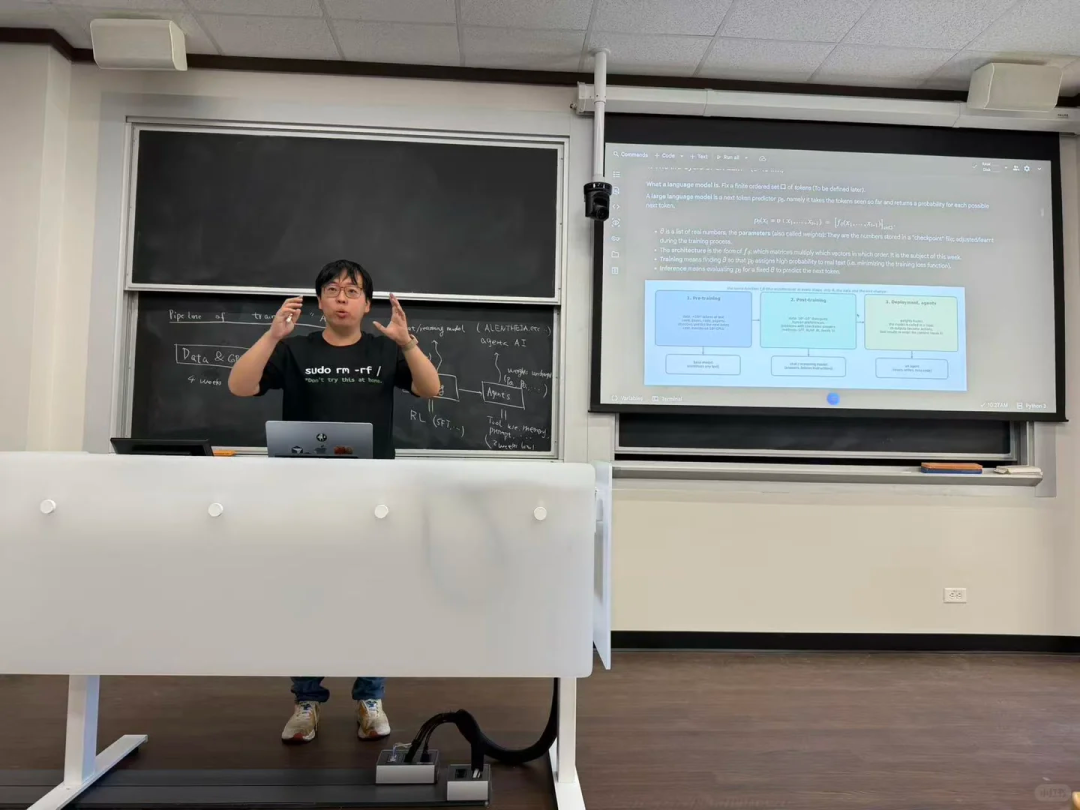
What AI tools do mathematics researchers need to master? Stanford University inFall 2026The MATH 289 course offered provides a study catalog worth referencing.
Course nameMathematical Practice in a Changing World(Mathematical Practice in a Changing World), for doctoral students in mathematics,No prior programming or AI experience required. The course is taught by Otis Chodosh and co-taught by Shurui Liu and Fred Rajasekaran.
The tentative outline currently released contains seven themes:
- 1. Programming basics: Terminal, Python, NumPy/PyTorch, Git/GitHub, and the use, security and permission settings of programming agents.
- 2. deep learning: Neural Networks and Optimizers.
- 3. Large language model architecture: Word segmentation, embedding, attention, MLP, mixed expert model (MoE) and decoding sampling.
- 4. Thinking chain and reasoning model: Introducing reinforcement learning around the ideas of papers related to o1 and R1.
- 5. agent: Prompt words and context engineering, agent engineering, and programming agent skills and memory.
- 6. Formalization and Lean Basics: Getting started with Lean and its core.
- 7. Practical calculation problems: GPU memory and computing power, API and GPU cost estimates, and Roofline performance model.
The opening readings of the course are also very interesting: one is "On Proof and Progress in Mathematics" by Thurston, and the other is "The Use of AI in Mathematical Research" by Etingof. Both articles have introductions to numbers. From how mathematicians understand proofs and research progress to how to use today's AI tools, these two articles provide a starting point for further learning.
The course website has provided some programming guides and Colab notebooks for machine learning and large model architecture; subsequent arrangements will be updated. For readers who want to understand how AI enters mathematical research, this outline can serve as a learning clue.
In the future, I will continue to add interpretations of specific manuscripts, focusing on the reading articles, lecture notes and related papers in the course, to introduce the core ideas and their connections with mathematical research.
Course homepage: https://web.stanford.edu/class/math289/
Course catalog and materials: https://web.stanford.edu/class/math289/schedule/
Machine-translated from the Chinese original 斯坦福开设 AI 与数学研究课程:从编程基础到 Lean 形式化证明 (published 2026-10-19). WeChat original ↗